The short answer
A website relaunch is the rebuild of an existing website: new design, new structure, often a new system as well. It pays off when the website no longer brings in enquiries, can no longer be run securely or no longer shows your company as it is. With us, a relaunch takes six to eight weeks. The biggest risk is not the design but the loss of visibility. Rankings belong to individual addresses, not to the domain. If you don't redirect old URLs with a 301 to matching new pages, you lose visitors from Google and, by now, from the answers of AI assistants too. Google recommends keeping redirects for at least a year.
A relaunch is not a fresh coat of paint
A redesign changes how your website looks. A relaunch changes how it works: which pages exist, what they are called, where they live, which system you maintain them with and what is on them. That is exactly why it is riskier than most people think. To Google and to AI assistants, a website is not a facade but a collection of individual addresses. Each of them has collected rankings, links and trust over the years.
We learned this on our own website. Our second-to-last version looked stronger than the one before, but it was more image than sales. It brought fewer enquiries and was found less often. For the new wagemut.studio in October 2026 we therefore followed a clear order: enquiries first, image second. And above all: the visibility we already had must not get lost.
When a website relaunch pays off
The website no longer brings in enquiries. Visitors come, but nobody gets in touch. Or no visitors come at all. Both can be the website's fault, but they don't have to be. More on that in a moment.
The system is a security risk. An old PHP version, a theme without updates, plugins nobody maintains anymore. At the latest when a vulnerability like PHP2Shell becomes public, a cosmetic flaw turns into an operational risk.
The website shows a company that no longer exists in that form. New services, new markets, a new brand, a change in management. If you often find yourself saying “That's not quite what the website says” in sales conversations, it's time.
You can't change anything yourself. Every new case study, every job ad and every trade fair date needs an agency. Then the site goes stale without anyone wanting it to.
The structure doesn't match what customers search for. A single page for all services, product names nobody but you knows, no answers to the questions buyers have before the first call. Often only a new structure can fix that.
When you don't need a relaunch
The honest answer first: not every website that looks old needs to be rebuilt. If it brings in enquiries and runs cleanly, a targeted revision of individual pages is often enough. And if nobody comes by, it is rarely the website's fault. What's missing is the way there: visibility on Google, in AI answers, in trade media. A new facade changes nothing about that. What a new website really costs over three years, we have calculated here.
How a website relaunch works
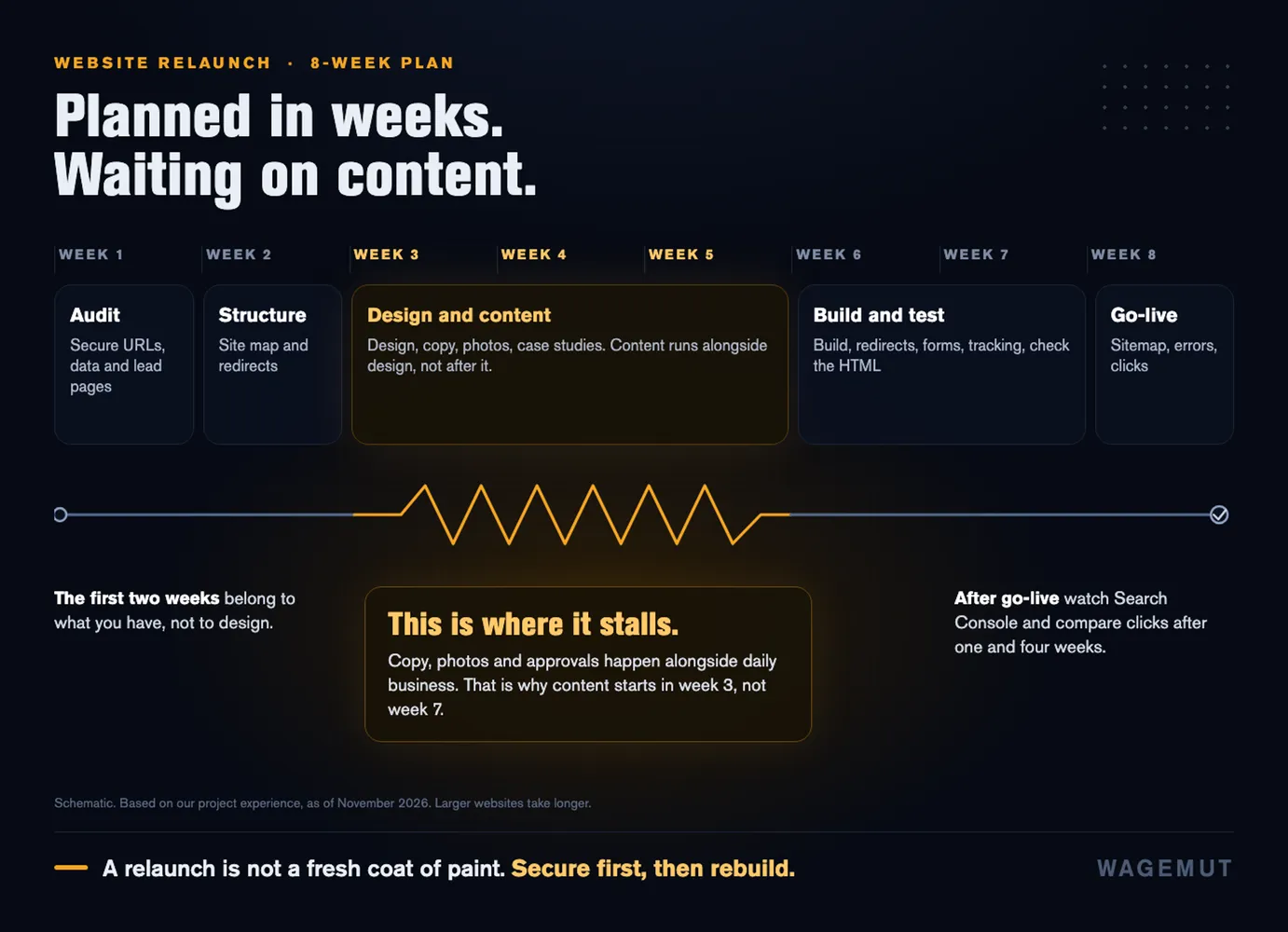
With us, a new website goes live in six to eight weeks. That works because the first two weeks don't belong to design but to what's already there.
| Week | Phase | What happens |
|---|---|---|
| 1 | Audit | Record every address of the old website, plus traffic, rankings, external links and the pages that bring in enquiries. Back up the Google Search Console data, it only goes back 16 months. |
| 2 | Structure | Site map based on the terms customers actually search for. Define for every old address where it will lead in future. |
| 3 to 5 | Design and content | Design, copy, images, case studies. Content is created alongside the design, not after it. |
| 6 to 7 | Build and test | Build in the new system, set up redirects, check forms, tracking and mobile display. Verify that the text is in the delivered HTML. |
| 8 | Go-live and monitoring | Switch over, submit the new sitemap, watch error pages and indexing, compare clicks on the most important pages after one and after four weeks. |
Where it almost always stalls: content. Design and technology can be planned. Copy, photos and approvals not so easily, because they happen alongside daily business. In our experience, a relaunch that slips by weeks is mostly waiting for content and rarely for code. That's why content starts in week three with us, not in week seven.
The six most expensive relaunch mistakes
Old addresses lead nowhere. The classic. The new website has new URLs, the old ones return an error page. Google then sees a website whose good pages have vanished. SISTRIX describes a case in which a website lost a third of its traffic within two days of switching systems. Google advises mapping every old address to a new one and redirecting it with a 301. According to Google, such permanent redirects don't cost any PageRank, so no link equity.
Everything points to the homepage. Anyone who wants to skip the mapping redirects everything to the homepage. Google explicitly advises against redirecting many old addresses to a single, unrelated target. Someone looking for a product page doesn't want to land on the homepage.
The block from the test phase goes live too. During development, the new site shouldn't appear on Google. If the noindex tag or the block in robots.txt stays in place after go-live, the entire website disappears from search. It takes five minutes to check and is still often forgotten.
Good content gets thrown out. An old page doesn't fit the new design and gets cut. That it has been bringing in enquiries for years or is cited by an AI is only visible in the data from week one.
The text is stuck in JavaScript. Modern websites often load content only in the browser. Google can read that by now. According to an analysis by Vercel, however, the crawlers of OpenAI, Anthropic and Perplexity don't execute JavaScript. Whatever is not in the delivered HTML doesn't exist for them.
Nobody looks after go-live. Google itself says that rankings fluctuate temporarily during a move. For small and medium-sized websites it takes a few weeks until most pages have moved. If you don't watch error pages and indexing in Search Console during that time, you only notice problems when the enquiries stop.
What a relaunch means for your AI visibility
There are no special rules for AI Overviews and AI Mode on Google. A page has to be indexed and eligible to appear as a result with a snippet, then it can also show up as a source in an AI answer. Everything that makes a relaunch risky for Google therefore applies to AI as well. Three things come on top.
AI assistants cite specific pages. When ChatGPT, Gemini or Claude name you, they often link to a specific subpage, such as a product or a case study. Even without a relaunch, users coming from there land on error pages more often than via Google. Ahrefs checked 16 million cited addresses: for AI assistants, 0.43 percent led nowhere, for Google 0.15 percent. Some of these are made-up links. A relaunch without redirects turns every cited page into another dead link.
The evidence sits on other people's sites. Trade articles, industry directories and partner sites link to your old addresses. These are exactly the sources assistants draw their reasoning from. If those links lead nowhere after the relaunch, you lose not just link equity but evidence.
New technology can lock out AI crawlers. If you move to a new host or a service like Cloudflare during the relaunch, check the crawler settings. It happened to us: after relaunching our website, Cloudflare's block for AI bots was switched on. For weeks, the crawlers of ChatGPT and Claude got an error message, even though our robots.txt explicitly invites them. Whether you allow AI crawlers is something you should decide deliberately rather than leave to the default.
How strongly search is shifting right now is covered in our article on more searches and fewer clicks on Google. The difference between the two worlds is explained in our comparison GEO vs. SEO. What else you can do is covered in our article on GEO optimization.
A relaunch can bring visibility
Done right, a relaunch is not just damage control. It is the best opportunity to align the structure with search. For our client Bücker, together with a partner for the backend, we built a website on which each of more than 23,000 IBM licences has its own subpage with a list price. Instead of a shopping cart, every page leads to a consultation. Before, fewer than 50 visitors a month came via Google search, today it is more than 1,200, with more than 1,000 search terms in the top 100. Without an ad budget. See the Bücker project.
Checklist for your website relaunch
- Export every address of the old website, including PDFs and images that get visited.
- Back up data from Search Console and Analytics.
- Mark the pages that bring in enquiries, rankings or links.
- Record whether, and with which pages, ChatGPT, Gemini and Claude name you today.
- Define a matching new target for every old address.
- End pages without a successor deliberately with 404 or 410, don't send them to the homepage.
- Set up redirects as 301 and keep them for at least a year, ideally permanently.
- Before go-live, check noindex, robots.txt and canonical tags, plus the crawler settings at your host.
- Check that the content is in the delivered HTML.
- After go-live, submit the new sitemap, look at Search Console daily and, after two and six weeks, ask the AI assistants the same questions as before.
Is a relaunch coming up for you?
Before you rebuild, it pays to look at what you need to take with you: which pages bring in enquiries, where you stand on Google and whether AI assistants already name you today. We look at that together in 30 minutes via Teams, free of charge. Book your relaunch call.
Sources
- Google Search Central: Site moves with URL changes
- Google Search Central: AI features and your website
- SISTRIX: Never relaunch a website without redirects
- Ahrefs: How Often Do AI Assistants Hallucinate Links? (16 Million URLs Studied), 2 September 2025
- Vercel: The rise of the AI crawler, 17 December 2024
- Cloudflare: Have it both ways – stay discoverable in search while disallowing AI training, 15 September 2026
- WAGEMUT: Bücker project