

The short answer
GEO optimization, short for Generative Engine Optimization and often also called AI search engine optimization, makes sure that AI assistants like ChatGPT, Gemini and Claude name your company when someone asks about what you offer, and that your pages show up as a source in Google's AI Overviews. It consists of five building blocks: a clearly named category, pages that answer questions completely, evidence instead of adjectives, a structure machines can read, and mentions on other people's sites. GEO pays off most for companies with products that need explaining and long buying cycles that are not yet at the top on Google. In the study that coined the term, it was precisely the pages ranked further down that gained the most.
What GEO optimization is
On Google, you fight for a position in a list. An AI assistant doesn't show a list. It answers in full sentences and names three or four providers on its own, each with a reason. GEO optimization is everything you do to make your company one of those names.
The term was coined at the end of 2023 by a team of researchers around Princeton University. In 2024 the paper was published at KDD, one of the major academic conferences for data analysis. The researchers' question was simple: what does a text have to look like for an AI to pick it up in its answer? Since then the term has caught on. Some say AEO, Answer Engine Optimization, others LLMO. They mean the same thing.
GEO is meant to work in three places: in the answers of ChatGPT, Gemini, Claude and Perplexity, in the AI Overviews above the Google results and in Google's AI Mode, which has also been available in German in Germany since October 2025. How this differs from classic search engine optimization is covered in our own comparison of GEO and SEO.
Why the topic belongs on the table now
The question is moving from the search bar into the chat. According to OpenAI, ChatGPT alone had 900 million users per week in February 2026. This is far from limited to consumers. In the B2B Monitor 2026 by the Swiss e-commerce consultancy Carpathia, 27 percent of the companies surveyed said they use AI to search for products and suppliers. Among companies with more than 50 employees it was 54 percent. The survey is small, 146 participants, but the direction is clear.
On Google, too, AI is answering more and more often. The number of search queries is growing faster than at any time in the past five years, but paid clicks are growing more slowly. In one experiment, clicks to external sites fell by almost 40 percent as soon as an AI Overview appeared. What that means for your website is covered in our article on more searches and fewer clicks on Google.
Not being named doesn't mean being in eleventh place. A buyer putting together a longlist takes the names from the answer. How hard this line is, we measured ourselves in October 2026: of 56 German machine builders from our network, Claude named 24 when we asked for manufacturers in their product category. 32 did not appear. That is a snapshot with one assistant and not a representative sample, but the line is clear. The answer has no page two.
The five building blocks of GEO optimization
None of them is a trick. And all of them pay off on Google too.
| Building block | What you actually do | Why it works |
|---|---|---|
| Name the category | Say in your customers' words what you make, and explain what sets you apart from the neighbouring category | An assistant only names those it can assign to a category |
| Complete answers | One page per product and service with applications, limits, figures and comparisons, the short answer right at the top | Assistants cite pages that answer a question conclusively |
| Evidence in the text | Figures, cited sources and quotes from experts instead of adjectives | The most effective methods in the Princeton study's lab test, 30 to 40 percent more visibility |
| Readable structure | Clear headings, question-and-answer blocks, structured data, every page understandable on its own | A page that stands on its own can be cited |
| Third-party mentions | Trade articles, directories, portals, partner sites, trade fair reports | An assistant trusts what several sources confirm |
Evidence beats buzzwords. The researchers tested various methods on a purpose-built test set of 10,000 search queries. Three worked best: citing sources, adding quotations and adding statistics. They made texts 30 to 40 percent more visible in AI answers. Classic keyword stuffing, on the other hand, performed worse than changing nothing at all.
The category has to exist first. An assistant can only name you if it knows what for. If you describe your machine with your own technical term that nobody uses outside your website, you won't be found. The assistant then lists the manufacturers of the neighbouring category instead. We saw this happen to a world market leader in our survey.
Mentions are half the work. In the same survey, the assistant drew its reasoning strikingly often from industry directories, company portals and even job boards, and less often from the named company's own website. If you only write about yourself on your own site, you remain a claim without evidence to the assistant.
Technology is a must, not a lever. Every website needs fast loading, mobile display and clean indexing. A page that search engines can't read, assistants read poorly too. But technology alone won't get you into the answer. Content and public relations do that.
Measuring replaces guessing. A fixed set of ten to twenty questions, put to ChatGPT, Gemini and Claude every three months and recorded with the date. How to do this properly is covered in our guide to AI visibility.
Ranked lower, gained the most
The finding of the Princeton study that matters most for mid-sized companies is hidden in a side table. The researchers looked at who the methods benefit: the pages that already rank at the top of search, or those further down.
| Method | Source ranked 1st | Source ranked 5th |
|---|---|---|
| Cite sources | −30.3% | +115.1% |
| Add quotations | −22.9% | +99.7% |
| Add statistics | −20.6% | +97.9% |
The result is clear. Pages ranked fifth became more than twice as visible with cited sources. Pages ranked first lost visibility with the same methods.
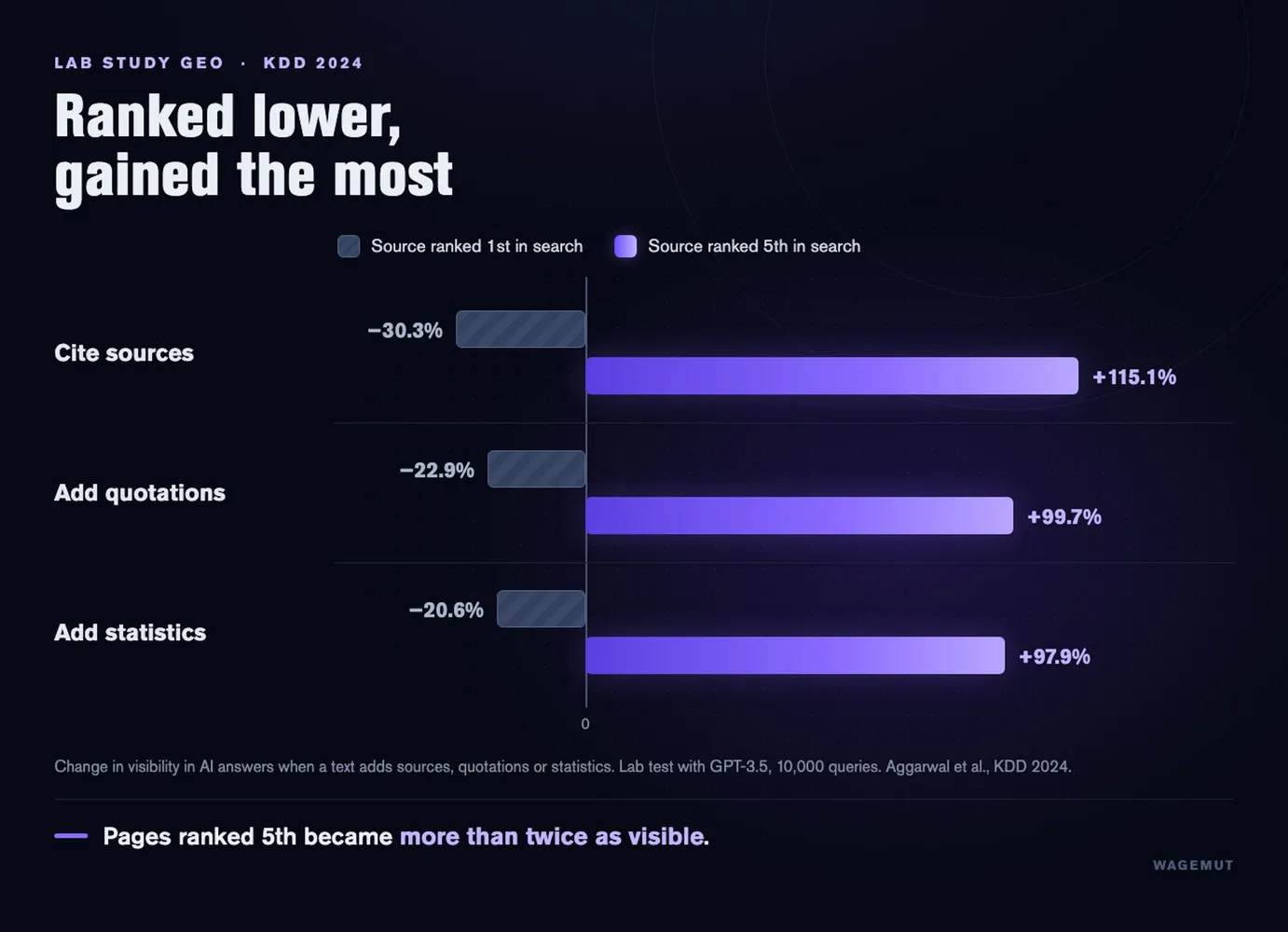
One caveat belongs here: this was a lab test from 2023 with an older language model. Today's assistants search differently and weigh things differently. But the direction matches what we see. In narrow niches where few providers are well described, the assistant also names small manufacturers, often in first place. For a mid-sized company that never stands a chance against the big corporations on Google, that is the real opportunity.
Who GEO optimization pays off for
Your customers do their research before they call. Anyone looking for a machine, a plant or a service with a five- or six-figure order value makes a list first. More and more often, that list is created in a conversation with an assistant.
Your product needs explaining. The more a customer has to understand before buying, the more likely they are to ask an AI to explain the differences. That is exactly where you want to appear as an example.
You occupy a niche. In our survey, 24 of 35 machine builders were named for sharp niche questions, none of 21 for broad categories. If you have a clearly defined category, you hold the best cards.
You are not at the top on Google. See above: those ranked lower have the most to gain.
A single order carries a lot. With long buying cycles and large orders, the work pays off as soon as one additional customer finds you through an AI answer.
Who GEO optimization can wait for
To be honest: GEO isn't the first step for everyone right now.
You live off local walk-in customers. For a business whose customers drop by spontaneously, a well-maintained Google Business Profile and genuine reviews usually bring more.
Your website isn't technically sound. If search engines can't read your pages cleanly, start there. What to watch out for when rebuilding so that no visibility is lost is covered in our article on the website relaunch. What a new website really costs over three years, we have calculated here.
You need enquiries within four weeks. GEO works over months, not weeks. For short-term enquiries, ads or direct outreach are faster.
Your order book is full through referrals, and you want to keep it that way. Then there are more important things.
What GEO optimization is not
Not a paid placement. Ads in ChatGPT appear as a separate, labelled block. The answer itself can't be bought. Why that is, is covered in our article on ChatGPT ads.
No guarantee. Nobody can promise you a mention. Answers vary from day to day and from assistant to assistant.
Not a replacement for SEO. GEO builds on SEO. If you have good content on Google, you already have the most important foundation for GEO.
Not a volume game. A hundred quickly generated texts make nobody worth citing. One page with verified figures beats ten pages of adjectives.
How to get started
Check where you stand. Ask ChatGPT, Gemini and Claude for the leading providers in your product category, not for your name. Note whether, in which position and with what reasoning you are named, and who is named instead.
One page that explains your category. For your most important product, a page that answers what a buyer wants to know before making a list. With figures, limits and the difference from the neighbouring category.
Three mentions elsewhere. A trade article, a complete directory listing, a report from a trade fair. Wherever third parties write about your category, you should appear.
Check again in three months. Same questions, same assistants. Only the comparison shows whether anything is moving.
What this looks like over the years when website, content and trade fairs run as one system is shown by our work for YASDA: plus 200 percent revenue in Europe since 2020.
Does GEO pay off for your company?
We check for you whether ChatGPT, Gemini and Claude name your company when someone asks about your product category, and tell you honestly whether GEO optimization pays off for you. Three assistants, several phrasings, with a written evaluation. It takes 30 minutes via Teams and costs you nothing. Book your free check.
Sources
- Aggarwal et al.: GEO: Generative Engine Optimization, KDD 2024 (arXiv)
- TechCrunch: ChatGPT reaches 900M weekly active users, 27 February 2026
- Google: AI Mode launches in Germany, Austria and Switzerland (German)
- Netzwoche: Larger companies rely more on AI in purchasing (Carpathia B2B Monitor 2026, German), 21 August 2026