
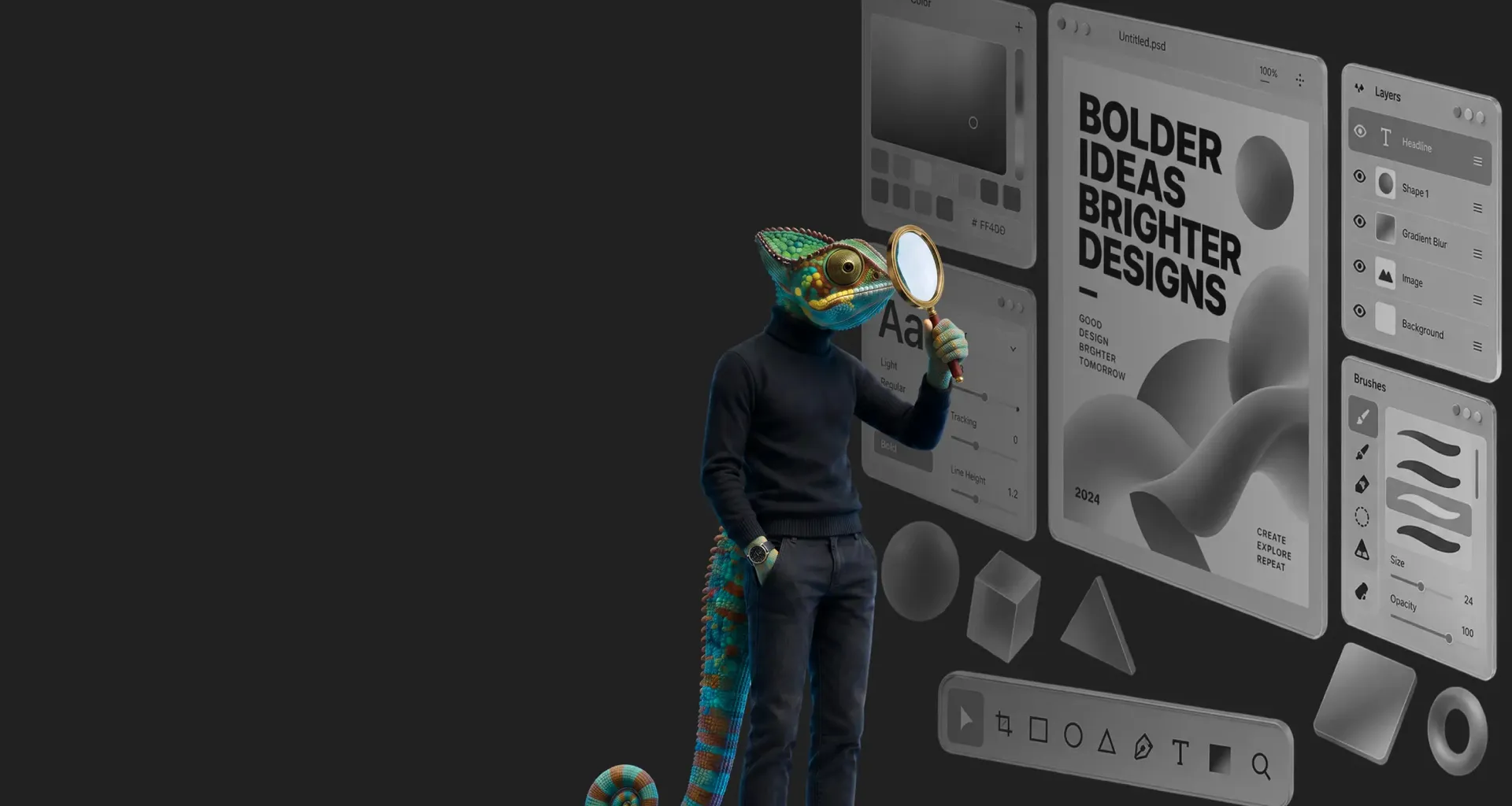
Business stationery
Business card, letterhead, folder, email signature. The first thing a customer holds in their hands, and often the last thing anyone takes care of.
What we design
Business card, letterhead, folder, email signature. The first thing a customer holds in their hands, and often the last thing anyone takes care of.
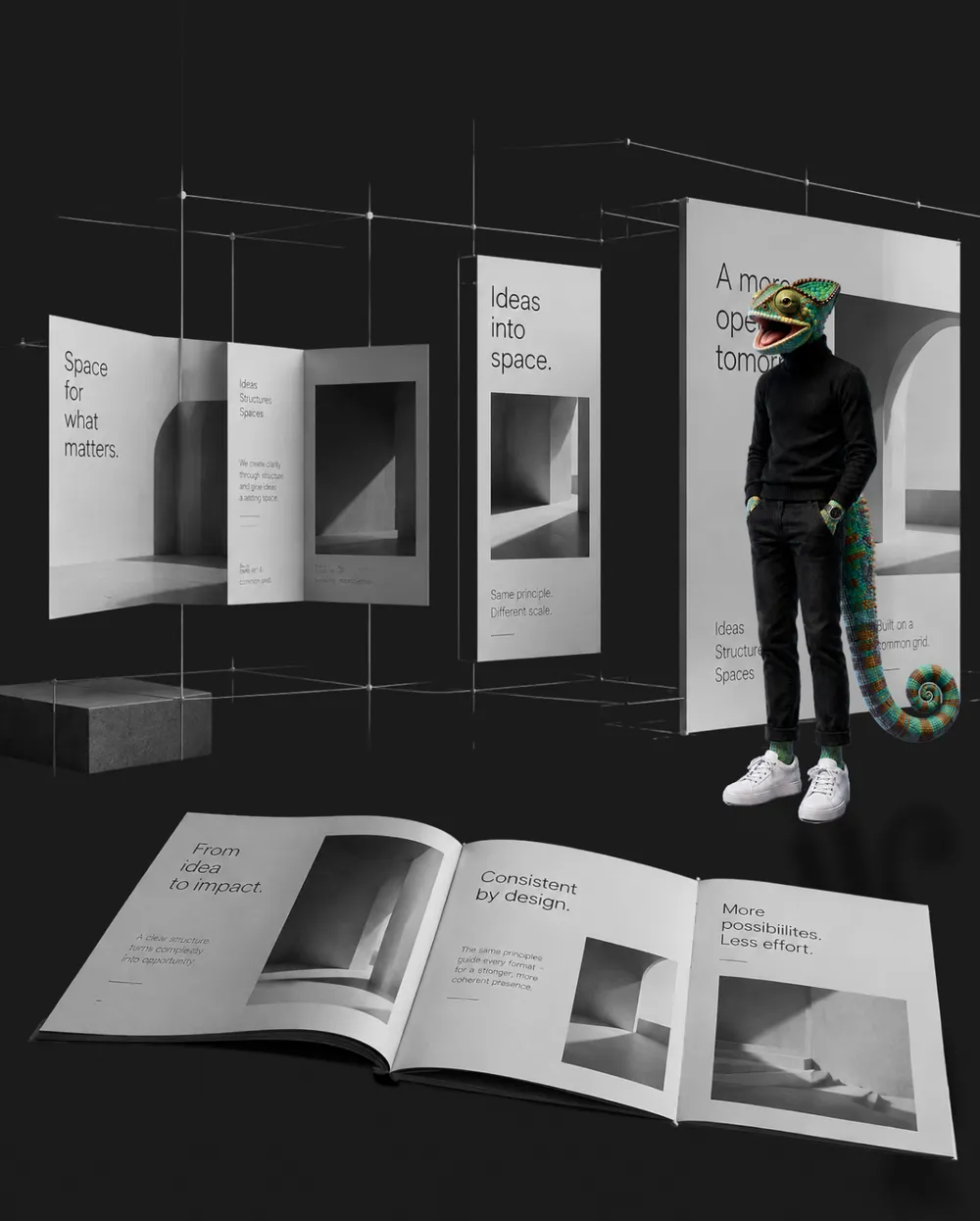
From eight to eighty pages. With a grid that still carries the twelfth spread.
For trade media, outdoor advertising and everything in between, in the dimensions the publisher asks for.
Wall, counter, roll-up, signage. Large surfaces call for different decisions than a page of paper.
Formats for the channels you actually run, plus templates you can carry on with yourself.
One-off or system
Most graphic design enquiries sound like this: we need a brochure. That's a clear task, and often it is exactly that. We do these one-offs without building a big project out of them every time.
It only gets interesting once the third piece comes along. When brochure, ad and trade fair wall grow out of the same logic, people recognize them together without having to look for the logo. When they come from three different sources, each one looks good on its own and none of them belongs to the others.
So if you need material regularly, a branding works out cheaper, even if it costs more at first. After that every further piece is done faster, because color, type and grid are no longer up for negotiation.
We say in the first conversation what makes sense in your case. At two printed pieces a year, the one-off is the honest answer.
What a grid does only shows from page three onwards. It sets where a heading starts, how wide a text column is and how much air an image gets. Without it, someone makes those decisions again on every page, and the brochure feels restless without anyone being able to say why.
A grid is faster, too. The first two spreads take their time, everything after that drops into prepared areas. That is exactly why a catalog with eighty pages doesn't cost ten times one with eight.
How we work
What should the piece do, who receives it, how is it produced. The format is decided here, not at the end.
Before anything is designed, it has to be clear what belongs on which page. Most layout problems are content problems.
One spread or one motif, standing in for all of them. Once that one is decided, the rest goes quickly.
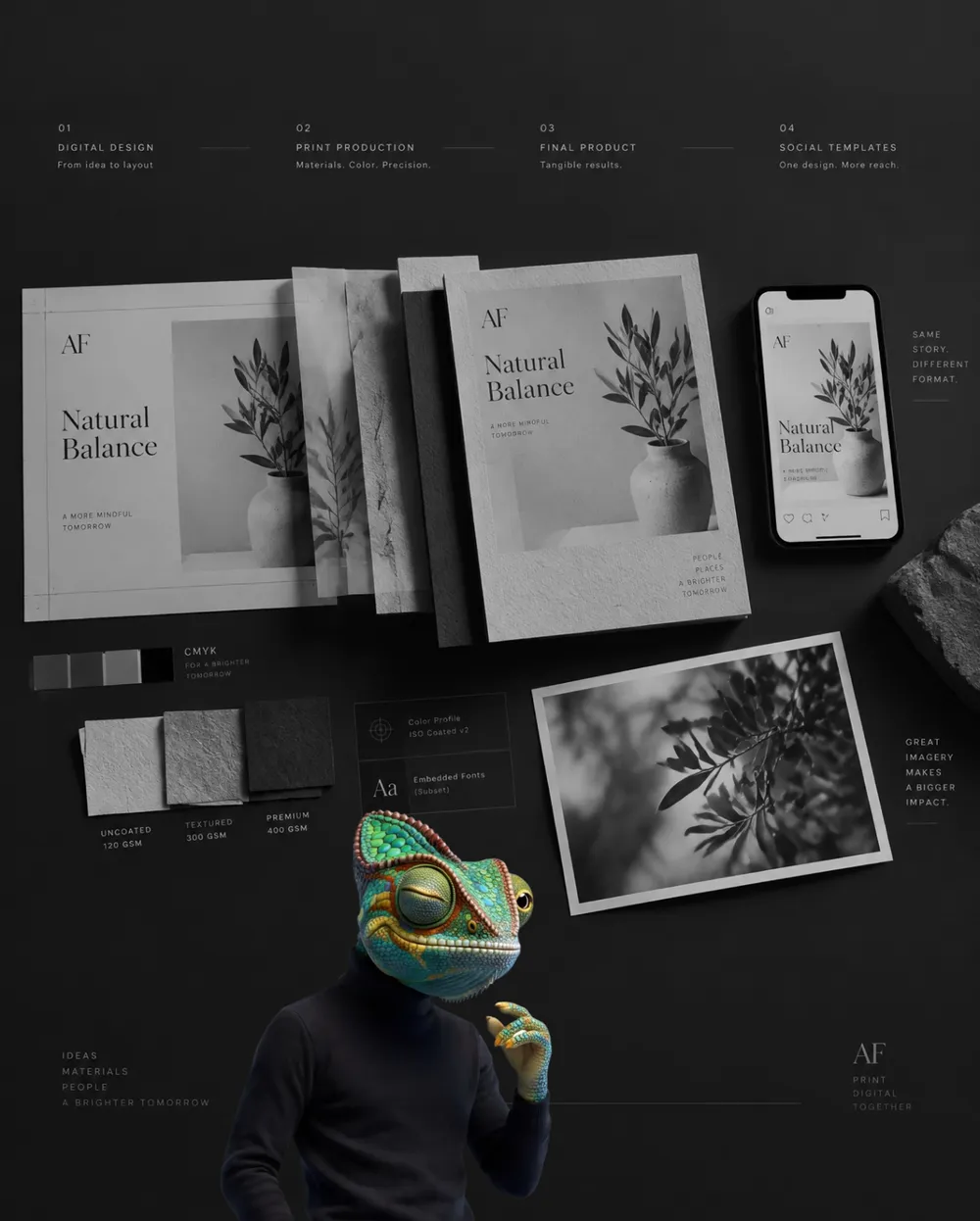
Print-ready files with bleed, the right color space and embedded fonts. We coordinate directly with your printer.
Professional Services
Building the company website with a redesign of the logo, a clear brand identity and a well-thought-out UI and UX concept for a modern and intuitive user experience.

Retail & Wholesale
Redesign of an online shop for horse products with a focus on UX, clear product pages and a well-considered site structure for an optimal shopping experience.
Hospitality & Leisure
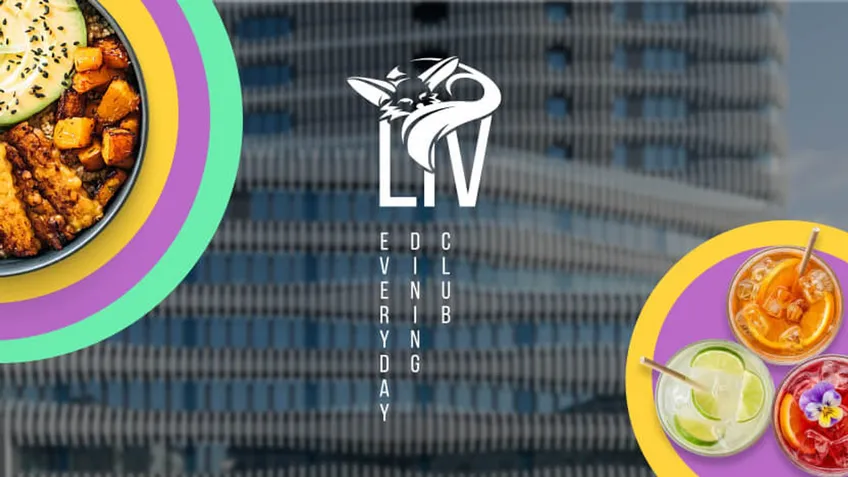
The branding for the robot restaurant on the ground floor of the RKM 740 in Düsseldorf-Heerdt covers the logo, color scheme, typography and menu.
All the way to the printer
Between the draft and the finished print lies craft you only notice when it is missing: bleed, color space, profiles, embedded fonts, paper that takes the color differently than the monitor shows it.
That's why we don't deliver layouts, we deliver print-ready files, and we coordinate directly with the print shop. If you don't have one, we get quotes. That costs you one email instead of three phone calls.
With larger print runs and special formats it goes beyond design: finishing, binding, choice of material. We cover that under Print media, because there production plays the lead role and the layout no longer does.
Digitally the same logic applies, just faster. Social media burns through material at a pace no agency can serve economically if every post is designed individually. So we build templates instead of one-offs: a set of grids that you fill with image and text yourself.
For that to work, the templates have to sit where the work happens. If you post with Canva, you get them in Canva, not as an InDesign file nobody can open. We settle that question beforehand, because it decides whether they are any use.
And a word on images: most design problems are really image problems. A clean grid cannot rescue a photo shot into the light. Where it's worth it, we say so in time and organize a shoot instead of building the layout around weak material.
Frequently asked
The effort depends on the scope and the state of the content, not on the format. An ad is typeset in a day, a catalog with eighty pages is not. We name the range after the briefing. For the Liv Dining Club the work ran from the naming through the logo family to the menu, the window graphics and the style guide. If you count as a small or medium-sized company, BAFA may fund part of it; the details are known to COZMOO.
No. Graphic design shapes fixed surfaces: a page, a poster, an ad. Web design shapes something that adapts to every screen size and reacts to clicks. The craft behind them is related, the rules are not.
It translates what a company stands for into something visible: brand, print, website, film. The difference from a single designer lies less in the craft than in the fact that several disciplines come from one source and fit together.
Yes. An ad or a brochure without a lot of fuss around it is a normal enquiry. From the third piece in a year on, though, we will talk about a system, because that is when it gets cheaper.
We deliver print-ready files and coordinate with your printer. On request we get quotes and see the production through, including approval on the proof.
Yes, that is the normal case. If guidelines are missing or contradict each other, we say so and suggest the smallest thing that solves the problem.