The short answer
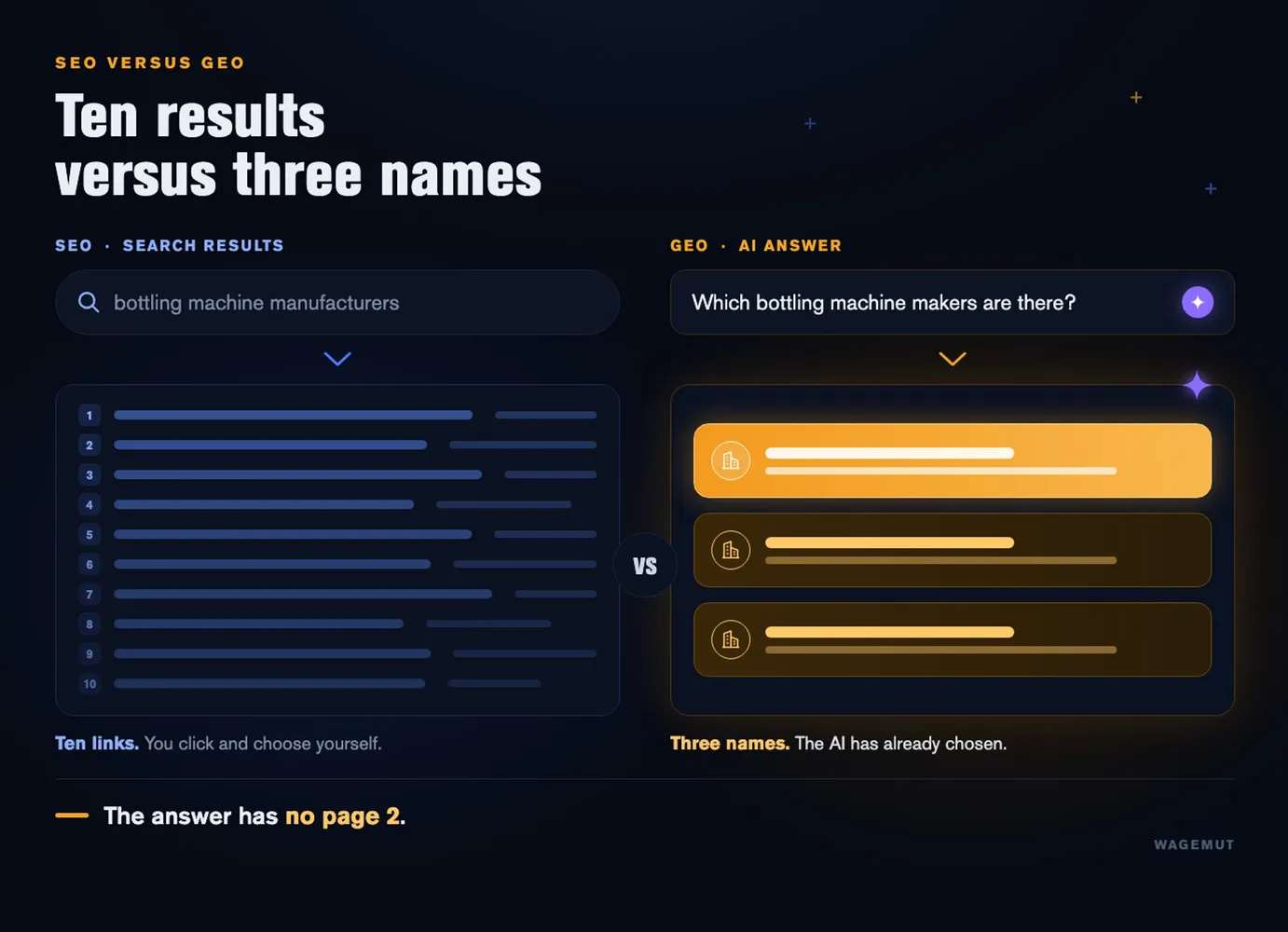
SEO gets you into Google's list of results. GEO, short for Generative Engine Optimization, gets you into the answers of AI assistants such as ChatGPT, Gemini and Claude, and into the AI overviews Google places above the results. The most important difference: on Google you compete for a position among ten results, in an AI answer for a mention among three or four names. What stays the same: both need content that answers questions completely, a clean technical foundation and authority. What changes: mentions on other people's sites count for more, clicks become rarer, and success is measured in mentions instead of rankings. GEO does not replace SEO. It builds on it.
Two terms, one goal
Anyone who has run a website in the last twenty years knows SEO, search engine optimization. The goal: when someone searches Google for your topic, you appear as high up the list as possible. The person sees ten results, clicks, compares and decides for themselves.
GEO is the newer term for the same intention in a different environment. More and more people no longer ask a search engine but an AI assistant. It doesn't show a list, it answers in full sentences and names a handful of providers on its own, each with a reason. The goal of GEO: to be part of that answer.
So both want the same thing. To be found when someone asks for what you offer. Only the rules of the game differ.
The difference at a glance
| Criterion | SEO | GEO |
|---|---|---|
| Where you appear | in Google's list of results | in an AI assistant's answer and in Google's AI overviews |
| Format | ten links, the user chooses | three or four names with reasons, the assistant preselects |
| Success means | a position on page one | a mention in the answer |
| Key signals | content, technology, links | complete answers, clear structure, mentions by third parties |
| What the user does | clicks, compares, decides | reads and adopts the preselection |
| Measurement | rankings, clicks, Search Console | mentions, position in the answer, cited sources |
What changes
The position becomes a mention
On Google there are gradations. Position three is worse than position one, but you are visible. In an AI answer, this gradation hardly exists. Either your company is among the three or four names mentioned, or it doesn't appear at all. The answer has no page 2.
We measured how hard this line is ourselves in October 2026. Of 56 mid-sized machine builders we checked, the AI assistant named 24 when asked for manufacturers in their product category. 32 didn't appear, among them companies that lead their niche worldwide. The full survey and how to run the check yourself are in our guide to AI visibility.
Clicks become rarer
Something is changing on Google itself, too. Many results now have an AI overview above them that answers the question directly. Anyone who already has the answer clicks less often. An analysis by SISTRIX for Germany from February 2026 shows: in position one, the click-through rate drops from over 27 percent to 11 percent as soon as an AI overview appears above it. According to SISTRIX, such overviews appear for around one in five search queries.
For you, this means: a good ranking brings fewer visitors than it used to. If you only look at clicks, you see losses without knowing where they come from.
Other sites count for more than your own
In SEO, links from other sites were one signal among many. In GEO, the question of what others write about you becomes the core. An assistant trusts what several sources confirm. In our survey, the source given for the reasoning was strikingly often an industry directory, a company portal or a trade article, and less often the website of the company named. If you only write about yourself on your own site, you remain an unsupported claim to the assistant.
Complete answers beat keyword pages
For a long time, a page that contained a search term often enough worked on Google. An assistant looks for something else: the page that answers a question conclusively. Areas of application, limits, comparisons, figures. And it has to recognise your category as a category in the first place. One world market leader from our survey is missing from the answer not because its machines are bad, but because nowhere is it clearly explained what sets its type of machine apart from the neighbouring one. So the assistant lists the manufacturers of the neighbouring category instead.
What stays the same
Good content remains the foundation
What convinces a person also convinces an assistant: concrete, substantiated, complete information. If you have been writing good content for Google rather than stacking keywords, you have already laid the most important foundation for GEO.
Technology remains a must
For current questions, many assistants search via classic search indexes, and Google's AI overviews use the Google index anyway. A page that search engines can't read properly is also hard for assistants to read. Loading time, mobile display, clean structure and structured data remain the prerequisite. Technology is a must, but it is not the lever.
Authority remains, it just has a different name
It used to be called backlinks, today it is more likely to be called mentions. The meaning is the same: other credible places confirm that you exist and what you stand for. Trade press, directories, partner sites, trade fair reports.
Google remains a major channel, and the two interlock
Google is losing clicks, but not its importance. And SEO and GEO reinforce each other. Seer Interactive found that pages cited as a source in an AI overview get around 120 percent more clicks per impression than pages that are not cited. So if you are in the answer, you also win in the list of results.
Why you don't have to choose
In practice, the question "GEO or SEO?" doesn't arise. GEO builds on SEO. The order is clear: first a technical foundation that search engines and assistants can read. Then content that answers your customers' questions completely. Then mentions outside your own website.
You don't need a second budget for this, but a different weighting. Fewer texts written for a search term. More pages that answer a question conclusively. And more attention to where people talk about you outside your website. What this looks like over the years when you run both as one system is shown by our work for YASDA: plus 200 percent revenue in Europe since 2020, with website, content and trade fair as one system.
What you can do now
Check where you stand. Ask ChatGPT, Gemini and Claude for the leading providers in your product category, not for your name. How to do this properly is explained in our guide to AI visibility.
One page per category that answers completely. A separate page for each product and each service that answers what a buyer wants to know before drawing up a list.
Build mentions. Trade articles, directory entries, partner sites, trade fair reports. Wherever third parties write about your category, you should appear.
Measure both. Rankings and clicks in Search Console as before. In addition, ask the assistants the same questions every three months and note the date. Only the comparison over time shows whether anything is moving.
If it turns out that your website can't support all this: we have calculated over three years what a new website really costs.
Want to know where your company stands today?
We check for you whether ChatGPT, Gemini and Claude name your company when someone asks about your product category. Three assistants, several phrasings, with a written evaluation and concrete recommendations. It takes 30 minutes via Teams and costs you nothing. Book your free check.