

The short answer
What it costs to have a website built in 2026 depends heavily on the route you take. A website builder such as Wix, Jimdo or Squarespace costs around €10 to €45 a month, and you build it yourself. A freelancer usually charges €1,500 to €5,000, an agency €3,000 to €20,000 and more. But these figures only show the price, not the bill. In our three-year example calculation, the subscription makes up only about an eighth of the cost of a website builder. The biggest item is your own time. So if you are comparing websites, calculate three things: the cost over three years, what you own at the end, and how many enquiries the website brings in during that time.
The three routes and what they cost
If you need a website, you essentially have three options. You build it yourself with a website builder, you hire a freelancer, or you go to an agency. The price ranges are wide, because "a website" can be anything from a three-page business card to a sales tool with a product catalogue.
| Route | One-off | Ongoing | Typical for |
|---|---|---|---|
| Website builder (Wix, Jimdo, Squarespace) | €0, you build it yourself | around €10 to €45 a month | business card, start-ups, small scope |
| Freelancer | around €1,500 to €5,000 | hosting and maintenance, often €20 to €60 a month | clear scope, site based on a template |
| Agency | around €3,000 to €20,000 and more | hosting, maintenance and further development, often €100 to €500 a month | products that need explaining, sales through the website |
On its own, this table is misleading. It suggests that the website builder costs next to nothing and the agency many times as much. Both are only true as long as you mistake the monthly price for the bill.
The bill over three years
A website does not run for one month, it runs for years. That is why we calculated what each route costs over three years for a typical company website with around ten pages. Including everything that goes with it, and including the time you put in yourself. We valued your own working time at €50 an hour, which is on the cautious side for management or marketing.
| Item over 36 months | Website builder | Freelancer | Agency |
|---|---|---|---|
| Build, one-off | €0 | €3,500 | €12,000 |
| Subscription, hosting, maintenance | €900 (€25 a month) | €1,440 (€40 a month) | €4,320 (€120 a month) |
| Add-on apps and templates | €360 | included in the build | included in the build |
| Your time for build and coordination | 40 hours | 15 hours | 20 hours |
| Your time for upkeep | 72 hours (2 a month) | 36 hours (1 a month) | 18 hours (half an hour a month) |
| Your time in euros | €5,600 | €2,550 | €1,900 |
| Total over three years | around €6,900 | around €7,500 | around €18,200 |
Three things stand out.
The monthly price is an eighth of the bill. With a website builder, €900 in subscription fees show up in the books after three years. The actual cost is almost €7,000. You pay the rest not with money but with evenings spent writing copy, cropping images and finding out why the contact form isn't arriving.
Website builder and freelancer are almost level. Over three years, around €600 separates the two. The supposedly cheap route is only cheap as long as your time costs nothing. Market overviews come to a similar result: the price advantage of a website builder is often used up after about a year and a half.
The agency is more expensive, and that is exactly why it has to deliver more. A difference of a good €11,000 over three years is not a detail. Whether it pays off is not decided by the cost side of the calculation, but by the other side.
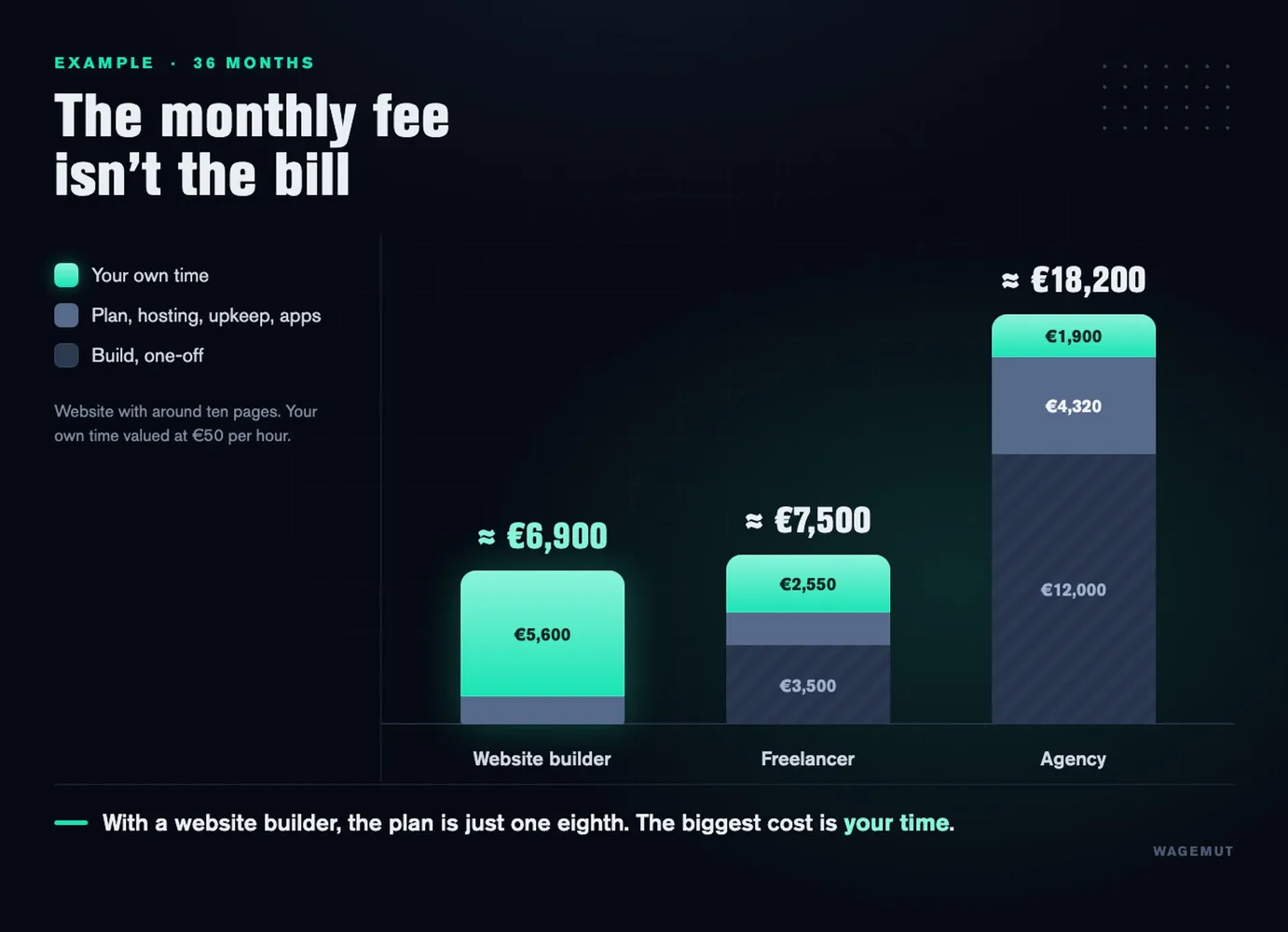
Your own figures will look different. If you are quick yourself, you need fewer hours. If you work in several languages or need a shop, you end up higher on every route. The principle stays the same: calculate over three years and count your own time.
What the monthly price doesn't tell you
Your time. The biggest item, and the one hardly anyone factors in. Build, copy, images, legal pages, updates, small corrections. With a website builder you do everything yourself, with a freelancer or agency the coordination remains.
Features that only come later. A contact form with file upload, appointment booking, a second language, a cookie banner that really meets data protection requirements. Much of this sits in higher plans or in add-on apps with their own monthly price.
Moving. With a website builder you own the domain, but not the site. If you want to switch later, you take the content with you and rebuild the rest. With a freelancer or agency, too, it is worth asking who owns the code, the logins and the content. The system behind your site also determines how free you are later. More on this in our comparison of Webflow vs. Sanity and Astro.
Limits on loading time, structure and visibility. A website that is meant to appear on Google and in the answers of AI assistants needs a clean structure: every service on its own page, fast loading times, structured data. Website builders hit their limits here sooner. How to check whether your company is named in ChatGPT, Gemini and Claude is explained in our guide to AI visibility. What stays the same between Google and AI answers and what changes is shown in our comparison GEO vs. SEO.
Obligations. A legal notice, a privacy policy and proper consent for cookies belong on every company website. If you sell to consumers, for example through a shop, you have also had to meet accessibility requirements since June 2025.
The real question: What does the website bring you?
A website is not a monthly expense like a phone contract. It is a tool that has to pay for itself. That is why it is worth running the calculation backwards once.
Ask yourself: What is a new customer worth to you, after deducting the costs of serving them? Let's assume €5,000. Then the website builder from our calculation pays for itself if it brings you two new customers in three years. The agency pays for itself with four. So the difference between the two routes is not €11,000, but two additional customers in three years.
That turns it into a different question. No longer "What is the cheapest?", but "Which website brings me those two extra customers?" For a café with walk-in customers the answer is often: none, a website builder is enough. For a machine builder whose buyers research online first and then draw up a list, it looks different. How far this can go is shown by our work for YASDA: plus 200 percent revenue in Europe since 2020, with website, content and trade fair as one system.
How to recognise a fair offer
A good offer answers the questions that become expensive later before they are asked. Check every offer against these six points:
- Are copy and images included, or do you supply them yourself?
- Who owns the domain, website, code and logins, including after the collaboration ends?
- What does operation cost per month, and what exactly is included?
- Can you change content yourself without commissioning someone every time?
- Are loading time, mobile display, data protection and the basics for Google and AI assistants part of the offer?
- What happens if you want to switch later?
If one of these answers is missing, ask. An offer that is €2,000 cheaper but contains no copy and ties you to a system often ends up being the more expensive one.
Which route suits whom
The website builder suits you if you need a digital business card, are just starting out or your business runs mainly on referrals and walk-in customers. And if you have the time and inclination to build it yourself.
The freelancer suits you if the scope is clear, a good template is enough and you want a fixed contact person. Pay attention to the questions about ownership and maintenance.
The agency suits you if your website is meant to sell: products that need explaining, long buying processes, several languages, visibility on Google and in AI answers. Then it is not about a website, but about positioning, content and technology as one system.
Want to know which route pays off for you?
We work out with you what your website will cost over three years and what it needs to bring in to pay for itself. Honestly, even if the answer turns out to be a website builder. 30 minutes via Teams, free and without obligation. Book a free initial call.