The short answer
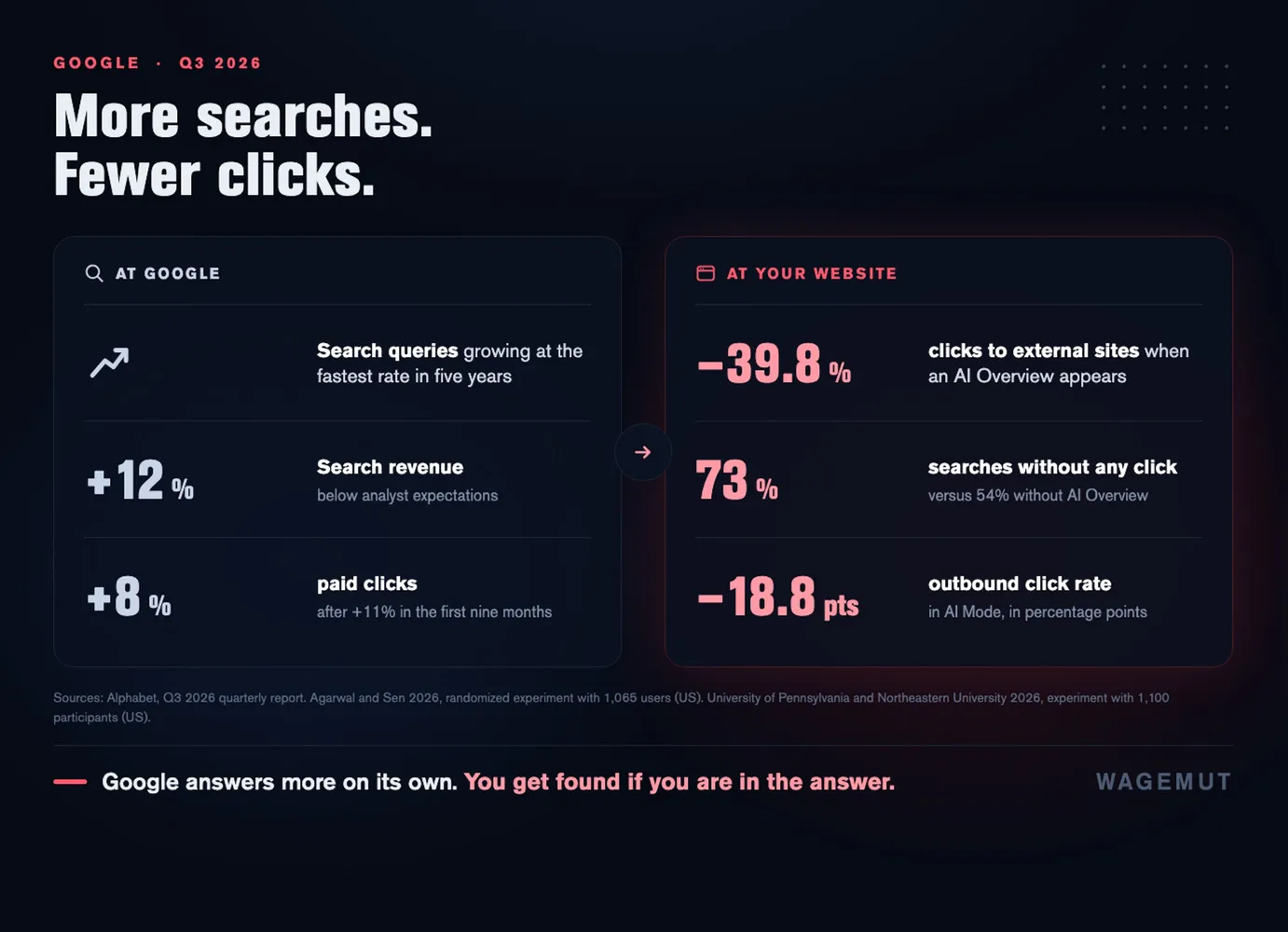
At the end of October 2026, Google showed what AI is doing to search. The number of search queries is growing faster than at any time in the past five years. Paid clicks in search, however, grew by only 8 percent in the third quarter, after 11 percent on average over the first nine months. Search revenue rose by 12 percent to 63.4 billion dollars and fell short of expectations, and the share price lost around ten percent the following day. Behind this is cannibalisation: with AI Overviews and Google AI Mode, Google answers more and more questions itself instead of pointing to websites. For companies, that means fewer clicks, even with a good ranking. In one experiment, clicks on external sites fell by almost 40 percent as soon as an AI Overview appeared. If you want to keep being found, you have to appear in the answer itself.
What Alphabet reported
On 28 October, Alphabet, Google's parent company, published its figures for the third quarter of 2026. At first glance, a record quarter. At second glance, it contains a shift that affects every company that wants to be found via Google.
| Metric | Q3 2025 | Q3 2026 | Change |
|---|---|---|---|
| Alphabet total revenue | $102.3bn | $127.6bn | +25 % |
| Google Search & other | $56.6bn | $63.4bn | +12 % |
| Paid clicks in search | +8 % (first nine months: +11 %) | ||
| Cost per click | +4 % | ||
| Google Cloud | $15.2bn | $30.7bn | +103 % |
Analysts had expected around 64.9 billion dollars for search; it came in at 63.4. The share price fell by around ten percent the next day. High spending on data centres also weighed on it, but search was at the centre of the debate.
What is interesting is the contradiction in the figures. Google CEO Sundar Pichai stresses that the AI investments are driving growth in search queries, including commercial queries, at the fastest pace in five years. At the same time, paid clicks are growing more slowly than before. More questions, but fewer clicks per question: that is exactly the effect this is about.
Analysts read this differently. Bank of America speaks of a small headwind from the shift to AI Overviews, probably larger outside the USA. Deutsche Bank currently sees AI Mode as a drag on monetisation. BMO counters that most searches in AI Mode are additional. They all agree on one point: search is changing fundamentally right now.
Why Google is competing with itself
Cannibalisation means that a new product eats into part of the old one. At Google, the old product is the list of results. You ask a question, get ten links and a few ads, and you click. Google earns from that click if it is an ad, and you earn from it if it is your website.
The new product is the answer. Many results now have an AI Overview above them that answers the question directly. In AI Mode, which has also been available in Germany in German since October 2025, Google holds an entire conversation, with follow-up questions and summaries. And the Gemini app, Google's own AI assistant, now has more than a billion users a month.
Google has no choice. If it didn't deliver answers, ChatGPT, Claude and other assistants would answer the questions. So Google builds the answer itself and accepts that there will be fewer clicks. To make it pay off anyway, the ads move along: Google now also shows advertising in AI Overviews and in AI Mode and, according to management, is expanding this outside the USA as well.
For Google, this is a business model being rebuilt. For you, it is a new first page, and on it there are no longer ten links, but one answer.
What this means for clicks on your website
Two experiments in 2026 measured how strong the effect is, both with real users in the USA.
Almost 40 percent fewer clicks. Researchers from Carnegie Mellon University and the Indian School of Business used a browser extension to randomly control which of more than 1,000 users saw AI Overviews and which didn't. Where an overview appeared, clicks on external sites fell by 39.8 percent. The share of searches after which nobody clicked at all rose from 54 to 73 percent. Clicks on ads and on Google's own offerings, by contrast, stayed the same. So the loss hits the organic results, your website.
Even clearer in AI Mode. A second experiment by the University of Pennsylvania and Northeastern University with 1,100 participants found: people searching in AI Mode clicked on external sites 18.8 percentage points less often than in normal search.
Both studies have limits. They come from the USA, ran on desktop, and the effect shows mainly for informational questions, that is, everything starting with "What is", "How does" or "Which providers are there". For questions that already carry an intent to buy, the data is less clear. For Germany, analyses by SISTRIX show a similar picture; the figures are in our comparison of GEO and SEO.
The direction is clear: if you rank first on Google, you get fewer visitors than two years ago, even though nothing has changed in your ranking.
What this means for mid-sized companies
In B2B in particular, the shift hits exactly the phase in which customers are won. A buyer looking for a new supplier researches first: Which providers are there, what sets them apart, who fits us? Today, AI often answers these questions before anyone visits a website.
Three consequences matter.
Guides lose clicks, but not their value. Explanatory pages and trade articles get fewer visitors because the answer is already at the top. At the same time, these are exactly the pages from which AI builds its answers. Their value shifts from the click to the mention.
Visitor numbers are the wrong metric. If your impressions in Google Search Console are rising and clicks are flat or falling, that is not a fault of your website, but exactly this effect. What matters is whether you appear in the answer and whether enquiries result in the end.
Those who click want more. Anyone who still goes to a website after an AI answer has usually understood the basics and is looking for something specific. There are fewer of these visitors, but they are closer to an enquiry. Your website has to pick them up, not just inform them.
What you can do now
Look at Search Console. Compare impressions and clicks over the last twelve months. If the gap is widening, the shift is already affecting you today.
Ask the buyer's question. Ask Gemini, Google AI Mode and ChatGPT about your category, not about your company name: "Which manufacturers of … are there in Germany?" Are you in there? How to do this exactly is explained in our guide to AI visibility.
Build pages that get cited. A clear short answer at the top, evidence instead of adjectives, your own figures, a clearly named category. AI uses pages like these as sources.
Make sure you are mentioned outside your website. Trade portals, industry directories, trade fair reports, press. AI often bases its answers on other people's sites, not only on your own.
Align your website with enquiries. Fewer but more determined visitors need a clear next step: contact, appointment, quote.
Want to know whether AI names you?
We check for free whether ChatGPT, Gemini and Claude name your company when a customer asks about your category, and what you can do if they don't. 30 minutes via Teams, with a written evaluation. Book your free check.
Sources
- Alphabet: Third quarter 2026 earnings release (SEC, Form 8-K, Exhibit 99.1)
- Alphabet: Quarterly report for the third quarter of 2026 (SEC, Form 10-Q)
- CNBC: Alphabet Q3 earnings miss estimates. What analysts say
- PPC Land: AI Overviews cut publisher clicks 39.8% in first randomized study (Agarwal and Sen, SSRN 2026)
- TechWyse: Study, Google AI Mode cuts clicks (University of Pennsylvania and Northeastern University, arXiv 2026)
- Google: AI Mode launches in Germany, Austria and Switzerland (German)