The short answer
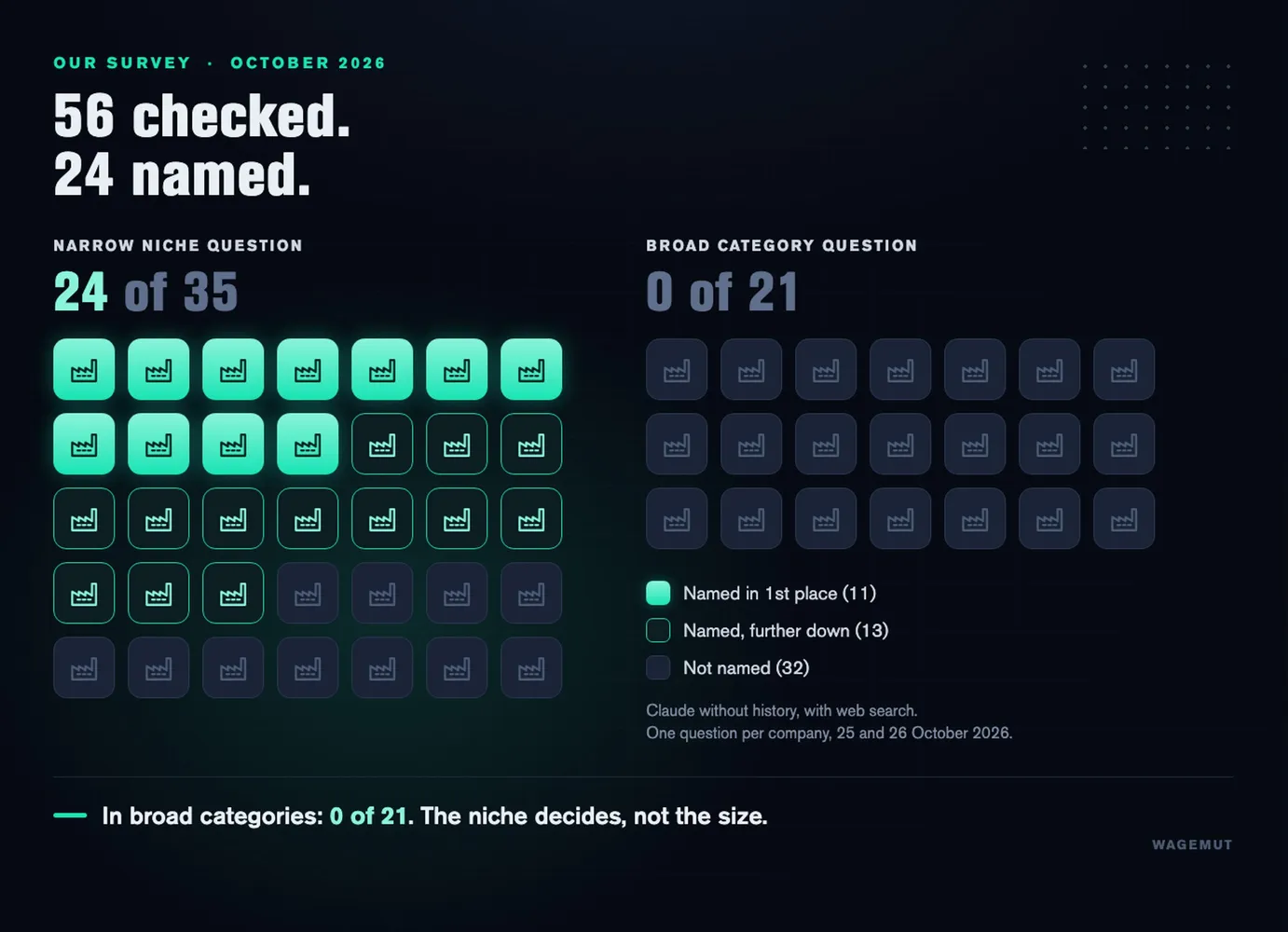
In October 2026, we checked for 56 mid-sized German machine builders whether an AI assistant names them when a buyer asks for manufacturers in their product category. 24 are named, 32 are not. Those who are named almost always appear near the top: 22 of the 24 among the first three, eleven in first place. AI visibility in mechanical engineering is decided by the category, not by size. For narrow niche questions, 24 of 35 companies were named; for broad category questions, none of 21, even though the assistant listed 13 providers on average there. The survey is a snapshot: one assistant, Claude, and one question per company.
Why we measured this
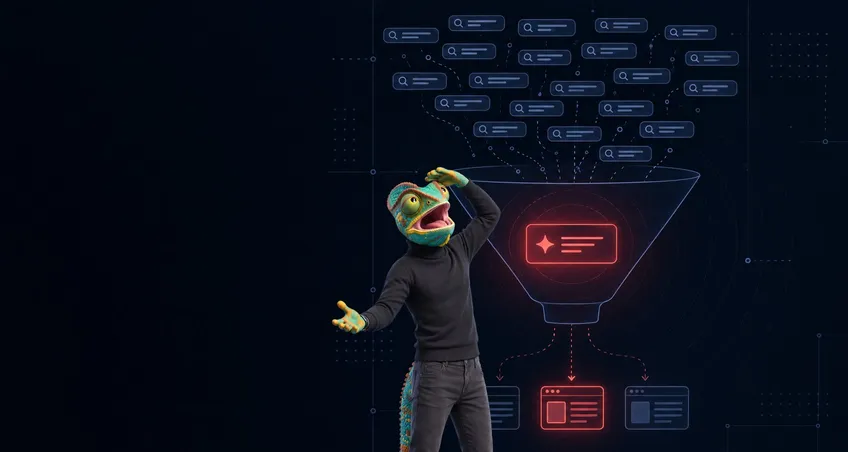
More and more buyers no longer type their question into a search bar but ask an AI assistant. It answers with three or four names and a reason. For managing directors in mechanical engineering, this is a new kind of longlist, and hardly anyone knows whether they are on it.
We are not aware of any comparable public figures for German mechanical engineering. So we measured it ourselves. Why this matters right now is shown by Google's latest quarterly figures: more searches, fewer clicks. This article is about the data.
How we went about it
The selection. 56 mid-sized German machine builders, across niches, from measuring technology through packaging and food technology to recycling plants. It is not a random sample but a selection from our own network.
The question. Exactly one question per company, asked the way a buyer asks it: "Which manufacturers of X are there in Germany? Name the leading providers." X is the product category, as specific as the company occupies it. For 35 companies, the category could be narrowly defined, a sharp niche. For 21, the category itself is already broad, such as automation technology, drive technology, refrigeration systems or plant engineering.
The assistant. Claude, in a fresh session without history and without memory, with web search enabled. A new session for each company. We asked on 25 and 26 October 2026.
The evaluation. Whether the company is named, in which position, with what reasoning, how long the list is, who is named instead and what the assistant bases its answer on.
The results in figures
| Metric | Value |
|---|---|
| companies checked | 56 |
| named in the answer | 24 (43 %) |
| not named | 32 (57 %) |
| of which in position 1 | 11 |
| among the first three | 22 of 24 |
| narrow niche question: named | 24 of 35 (69 %) |
| broad category question: named | 0 of 21 |
| length of answer for narrow niche question | 5.9 providers on average |
| length of answer for broad category question | 13.0 providers on average (3 to 30) |
Finding 1: The niche decides, not the size
In a niche, almost everyone is named. Companies that occupy a narrow category, concrete cooling systems, wafer baking plants or tube bending machines, are almost always in the answer and often in first place. The assistant finds only a few providers in these niches and names them all. The lists in which one of our companies was at the very top were short: mostly three or four names, and once the company even stood alone.
In broad categories, no one is named. As soon as the category becomes broad, the picture changes completely. The assistant listed 13 providers on average, once even 30. Those named were corporations and well-known brands. Of the 21 mid-sized companies we checked in broad categories, not a single one appeared. Several times, the assistant itself asked for the question to be narrowed down because the market was "highly fragmented".
That means: a long list is not an opportunity. The more names the assistant lists, the more it falls back on what everyone already knows.
Finding 2: Those who are named are at the top
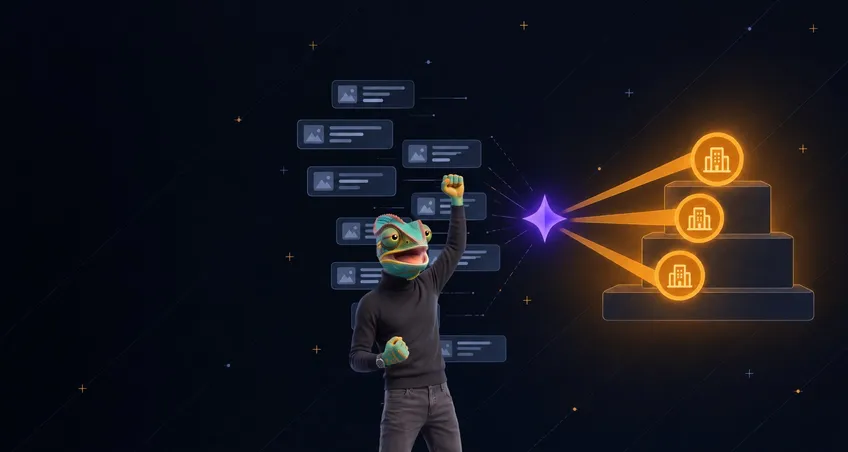
22 of the 24 companies named were among the first three, eleven of them in first place. Only two were further down, in sixth place out of eight and in eighth place out of ten.
So there is hardly a broad middle. Either a company belongs to the leading group, or it doesn't appear at all.
The reasoning also reveals a lot. For some companies, the assistant gave the year of founding, installed machines and individual product lines. For the company in eighth place, it gave only the location, nothing else. What an assistant says about you depends on what has been written about you.
Finding 3: Eleven specialists are missing from their own niche
Eleven companies serve exactly the niche asked about and were still not named. There would have been room: the lists were short, just under seven names on average. We see four patterns.
The category is not recognised. The assistant answers the question with the neighbouring category. A world market leader for strapping and tying machines is missing because manufacturers of strapping machines are listed instead.
The big players fill the list. In categories with well-known world market leaders, only these appear in the answer. For bottling plants, for example, the specialised mid-sized company is missing.
The neighbour is named. For emergency power generators, a regional competitor from the neighbouring town is in the answer, but not the manufacturer we checked.
Directories write the list. In a niche with eight providers named, three names clearly came from industry directories.
In none of the eleven cases is the product the problem. What is missing is text outside the company's own website that explains the category and names the company in it.
Finding 4: The sources are rarely the company's own website
Where the assistant gets its reasoning from is perhaps the most important finding. Strikingly often, the sources were industry directories, industrial portals, business magazines and even job boards. The website of the company named was less often the source.
One case shows this particularly clearly. For a regional question about contract manufacturing, the assistant declined to give a ranking and instead referred to platforms such as wlw, Techpilot and the directories of the chambers of commerce (IHK). If you don't have a complete profile there, you don't exist in this answer.
One side observation: the assistant derives the location from the internet connection and several times offered on its own to narrow the answer down to our region. So a buyer in Stuttgart gets a different list from one in Düsseldorf.
What the survey does not show
Every figure has its limit. Here there are five.
One assistant. We only asked Claude. ChatGPT and Gemini answer differently. How large the difference can be is shown by a special machine builder from the Rhineland that we checked in three assistants this autumn: exactly one mention in three answers.
One run. We asked each question once. AI answers fluctuate; tomorrow the list may look different.
Narrow questions. We asked as specifically as possible. Real buyers often ask more broadly. Then the rate falls, it doesn't rise. The 24 out of 56 are the favourable reading.
Not a random sample. The 56 companies do not represent German mechanical engineering as a whole.
One location. All questions came from North Rhine-Westphalia.
We are publishing the figures anyway because they show a pattern that was the same in all niches: companies that clearly occupy their category and are mentioned by third parties are in the answer.
What this means for managing directors in mechanical engineering
Find your sharpest category. Not "drive technology", but what only a few build the way you do. In that category, you have a real chance of first place.
Explain what sets you apart from the neighbouring category. On your website, in the words a buyer uses. Otherwise the assistant lists the neighbours.
Make sure you get mentioned. Complete profiles in directories and on platforms, trade articles, trade fair reports, partner sites. That is where the assistant gets its reasoning.
Check regularly. Ask ChatGPT, Gemini and Claude the same questions every three months. How to do this is explained in our guide to AI visibility.
That this pays off over the years is shown by a machine builder we have worked with for a long time: YASDA, plus 200 percent revenue in Europe since 2020.
Want to know whether your company is named?
We check for you whether ChatGPT, Gemini and Claude name your company when a buyer asks about your product category. Three assistants instead of one, several phrasings, with a written evaluation and concrete recommendations. It takes 30 minutes via Teams and costs you nothing. Book your free check.
Sources
- WAGEMUT Kreativstudio survey, 25 and 26 October 2026: 56 mid-sized machine builders, Claude without history with web search enabled, one question per company.
- Aggarwal et al.: GEO: Generative Engine Optimization, KDD 2024 (arXiv), for context on the term GEO.