The short answer
At the end of October 2026 we checked, for 56 German mid-sized machine builders, whether an AI assistant names them when asked about manufacturers in their product category. 24 are named, 32 are not. Those who occupy a sharp niche are almost always in, often in first place. Those competing in a broad category are almost always missing, no matter how good they are. You can check this for your own company, in five minutes and without any tool: Ask ChatGPT, Gemini and Claude for the leading manufacturers in your category, not for your company name, in a new chat, in several phrasings. Then read not only whether you are named, but in which position, with what reasoning, citing which sources, and who is named instead.
What AI visibility means
On Google, visibility was a position: page one or not. With an AI assistant, visibility is a mention. Someone asks for suppliers, and the assistant replies with three or four names and a reason. Either your company is among them, or it is not. There is nothing in between.
That is why AI visibility carries so much weight for companies with long buying processes. A buyer drawing up a longlist takes the names from the answer into the next meeting. Whoever does not appear there is not in eleventh place. He is simply not there. AI assistants' answers have no page two.
The numbers: 56 machine builders, 24 mentions
Before we get to the guide, the finding that sets the frame. We checked 56 German mid-sized machine builders across niches, from coordinate measuring machines to filling lines to impact crushers. For each company one question, asked the way a buyer asks it: "Which manufacturers of X are there in Germany? Name the leading suppliers." We asked Claude, in a fresh session without history, with web search switched on. We only recorded whether the company is named in the answer, in which position, and who else is named.
| Metric | Value |
|---|---|
| companies checked | 56 |
| named in the answer | 24 |
| not named | 32 |
| of those, in first place | 11 |
| sharp niche question: named | 24 of 35 |
| broad category question: named | 0 of 21 |
Three things stand out.
The niche decides, not the size. Whoever occupies a narrow category, concrete cooling systems, wafer baking lines, tube bending machines, is almost always named, and in eleven cases in first place. In these niches the assistant only finds a few suppliers and names them all. As soon as the category gets broad, automation technology, drive technology, refrigeration systems, plant engineering, it names corporations and well-known brands and often asks for a narrower question itself. Of 21 mid-sized companies in broad categories, not a single one appeared.
Specialised and still invisible. Eleven companies serve exactly the niche we asked about and are still missing. A world market leader for tying machines is not named because the assistant does not know the category as a category of its own and lists strapping manufacturers instead. A maker of emergency power generators is missing while its competitor from the neighbouring town is named. For filling lines, only the world market leaders are in the answer, not the specialised mid-sized company. In all eleven cases the product is not the problem. The problem is what can be found about the company outside its own website.
The sources are rarely the company website. Where the assistant took its reasoning from was strikingly often an industry directory, a company portal or a job board, less often the company's own website. Those who are in the answer are usually there because third parties write about them. That is the most important pointer for the lever further down.
Two caveats belong here. We asked one assistant and asked each question once. ChatGPT and Gemini answer differently, and Claude will answer differently tomorrow than today. And we deliberately asked narrow questions, tailored to each company's niche. Real buyers often ask more broadly. Then the rate goes down, not up. So 24 of 56 is the generous reading.
A single case shows what the broader check with three assistants reveals: A specialist machine builder from the Rhineland, a leader in his segment, had us check this autumn. Three assistants, several phrasings. Result: exactly one mention. World-class product, absent from two of three answers.
The five steps
Step 1: Ask about the category, not your name
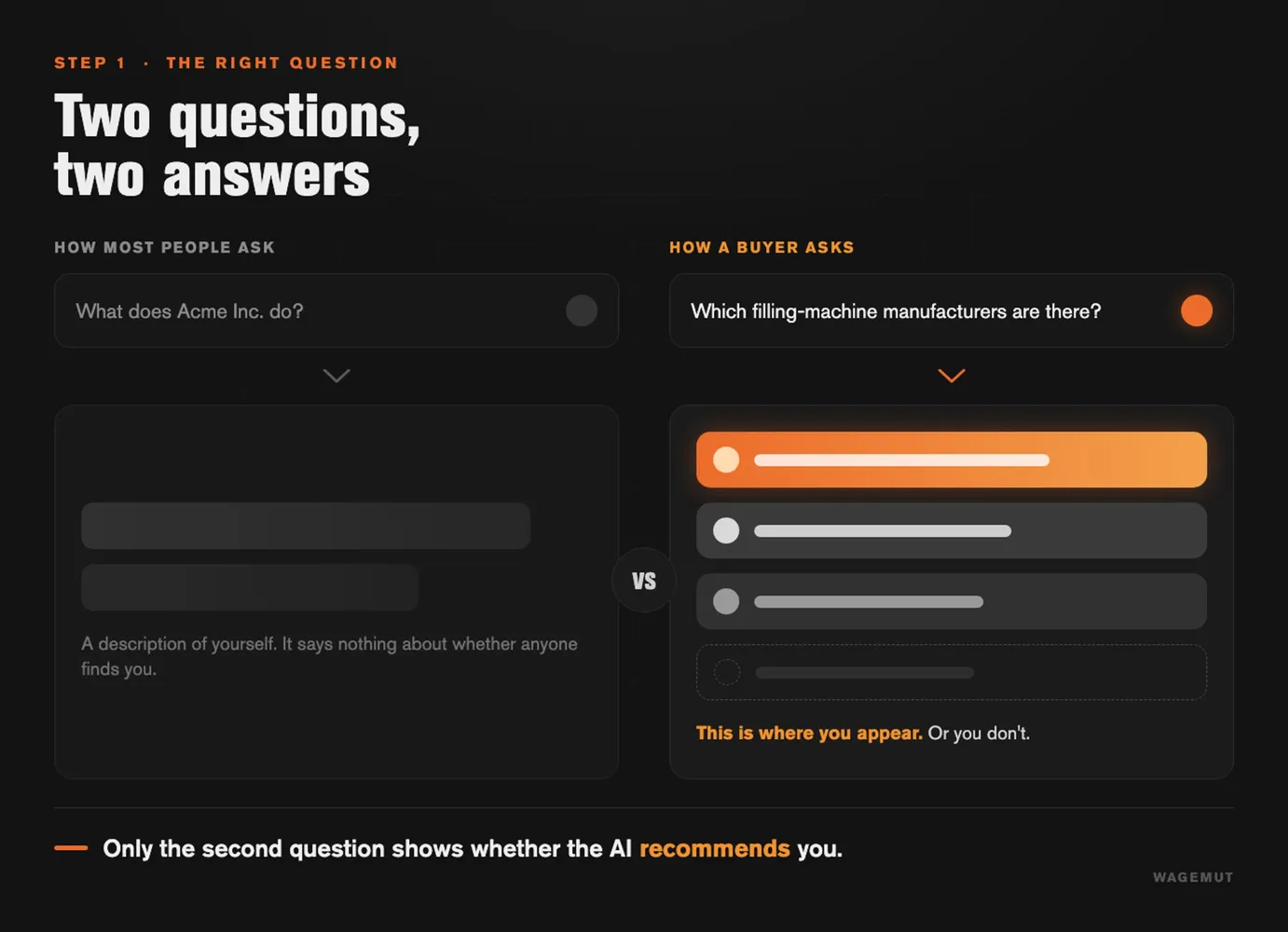
This is the most common mistake, and almost everyone makes it the first time. Enter your own company name and you get a description of your own company back and think all is well. Only, no customer searches like that. A buyer does not know your name. He asks for what he needs.
So the right question is not "What does Acme Inc. do?" but "Which manufacturers of filling lines for the beverage industry are there?" Use the term a buyer would type: the product category, not the model name, not the umbrella term "mechanical engineering". Two to four words, as specific as your offering. Our survey shows how much depends on this: The same company can be in first place for the narrow question and completely missing for the broad one.
Step 2: Ask three assistants, not one
ChatGPT, Gemini and Claude answer differently because they weight different sources and search differently. A company missing in ChatGPT can show up in Gemini and vice versa. Check only one assistant and you know a third of the picture. All three can be used for free, the check only costs you the minutes.
Step 3: Ask in a new chat, without history
An assistant remembers what you talked about before and colours later answers with it. If you asked about your own company earlier, it is more likely to name it afterwards. That skews the result. Open a new chat for every check, ideally in an account that knows nothing about your company. What you want to see is the answer a stranger gets.
Step 4: Ask several times, in different phrasings
AI answers fluctuate. The same question can return three different names today than tomorrow. That is why a single query is not enough. Ask the question in three or four variants: for manufacturers, for suppliers, for vendors, once with a region, once with an application. "Which manufacturers of machining centres for aluminium are there in Germany?" is a different question from "Who builds machining centres for aerospace?", and a buyer asks both.
One more point from our survey: The assistants derive your location from your connection and offer on their own to narrow the answer to your region. A buyer in Stuttgart therefore gets a different answer from one in Düsseldorf. So ask once without a region and once with the region where your customers are.
Step 5: Read the result properly
Whether you are named is only the first look. Four things tell you more:
In which position? First name or fourth? The order is not random, it reflects how sure the assistant is.
With what reasoning? Does it say "known for high precision in small batches" or just "a German manufacturer"? The reasoning shows what the assistant knows about you. If it is thin, your website is thin.
Citing which sources? Many assistants show where they got their answer from. If your website is listed there, good. If an industry directory or a competitor is listed there, you know where the authority lies.
Who is named instead? The names that appear instead of yours are the most important information of the whole check. They are the companies the buyer puts on his list.
Write the answers down, with the date. In three months, check again and see what has moved.
The most common mistakes when checking
Entering your own name instead of the category. Asking only one assistant. Carrying on in the old chat that already knows everything about you. Asking once and taking the result as permanent. And the subtlest one: choosing the category the way your company names it, instead of the way a customer searches for it. Whoever types "system solutions for the process industry" is checking something nobody asks for.
What the result means
You are not named. To the assistant, you do not exist. In our survey, that was the case for 32 of 56 companies. It does not mean your website is bad. It means it delivers no answers an assistant can quote, and that too little is written about you outside your own site. That is the most common situation among mid-sized companies, and it can be changed.
You are named, but described wrongly or thinly. The assistant knows you but does not understand you. Usually this comes down to a website that describes what the company can do instead of answering what a customer asks. This is where the lever is shortest.
You are named, described correctly, with your website as the source. Then you have AI visibility. The task now is to keep it, because the answers fluctuate and competitors are catching up.
What you can do if you do not show up
Three levers, in this order.
Content that answers questions. For every product category, a page that completely answers what a buyer wants to know: applications, limits, technical data, comparisons. An assistant quotes pages that answer a question conclusively. And it has to know your category as a category in the first place. The world market leader for tying machines from our survey is not missing because his machines are bad, but because nowhere does it say what distinguishes a tying machine from a strapping machine.
A structure a machine can read. Every product on its own page, with clear facts and structured data. A page that stands on its own can be quoted.
Mentions outside your own website. Trade press, directories, partner sites, trade fair reports. An assistant trusts what several sources confirm. In our survey, the sources quoted were more often industry directories and portals than the company website. Whoever only writes about themselves on their own site remains, to the assistant, a claim without evidence.
Loading speed, mobile display and security are a must, but they do not get you into the answer. Technology is a must, not the lever. Why advertising in ChatGPT does not help here either, we have written up in a separate article on ChatGPT ads. What it looks like when a company takes the topic seriously over years is shown by our work for YASDA.
Would you rather do the check with us?
We check for you whether ChatGPT, Gemini and Claude name your company when someone asks about your product category. Three assistants, several phrasings, with a written evaluation and concrete recommendations. It takes 30 minutes and costs you nothing. Book your free check.