The short answer
Being recommended by AI and being found on Google are two different things. ChatGPT, Gemini and Claude mainly name companies they can assign to a clear category and about which several independent sources say the same thing. A good Google ranking helps less than many people think: in an Ahrefs analysis, only 12 percent of the links that ChatGPT, Gemini and Copilot cited as sources ranked in Google's top ten for the same question. We call the distance between being found and being named the mention gap. In our own survey, Claude named 24 of 56 mid-sized machine builders, and not a single one for broad category questions.
The mention gap: found, but not named
The website works, the numbers are stable, and still no more enquiries come in. The product is rarely the reason.
Part of the explanation: more and more buyers no longer draw up their first list on Google but in a conversation with an AI assistant. It doesn't show ten results, it names three or four suppliers and gives reasons. If you're missing there, you're not on the list, no matter how well your website does on Google.
We call this distance the mention gap: a company is easy to find online, but when someone asks an AI about what it offers, it doesn't come up. Everywhere, yet never named.
How wide the gap can be was measured by Ahrefs in summer 2025 across 15,000 questions. Of the links ChatGPT, Gemini and Copilot cited as sources, on average only 12 percent ranked in Google's top ten for the same question. For most assistants, more than 80 percent of the sources came from pages that didn't rank for that question at all. So the AI often reads different pages from the ones at the top of Google.
Google shows a list, the AI makes a choice
A Google ranking is visibility. A mention in an AI answer is a recommendation. On Google, searchers decide for themselves which of the ten results to click. An assistant does that work for them. It reads, summarises and says at the end whom it would pick.
For that choice, it isn't enough that your website exists. A recommendation rests on what others say about you. Ahrefs examined this for 75,000 brands in Google's AI Overviews. The number of mentions was most strongly linked to how often a brand is mentioned on other sites, roughly three times as strongly as backlinks. That's a correlation, not proof of cause and effect. But the direction matches what we see in our audits.
It helps to look at which question a buyer asks where.
| Channel | The buyer's question | What decides the answer |
|---|---|---|
| Who offers this? | How well your pages rank for the search term | |
| Who are these people? | Profiles, posts and shared contacts | |
| AI assistant | Who should I contact? | Whether the AI assigns you to a category and third parties name you in it |
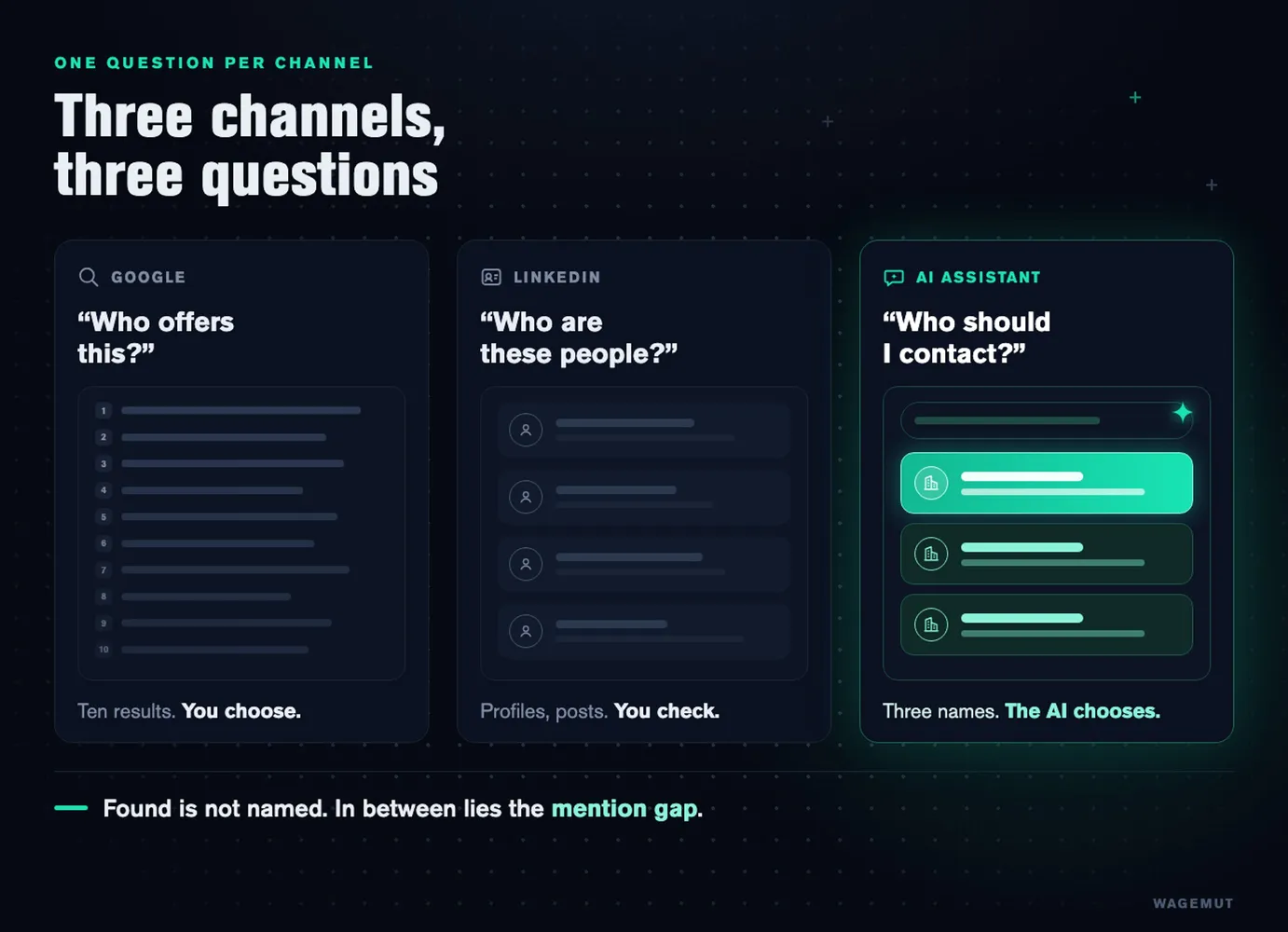
The third question is the closest to an order. Anyone asking whom to contact has almost made up their mind.
How an AI knows who you are
An assistant has two sources.
Its built-in knowledge. During training, the language model read large parts of the public web. Whatever was written about you there up to a cut-off date is in the model. New information only arrives with a new model version, and that takes months.
A search at the moment of the question. ChatGPT, Gemini, Claude and Perplexity can search the web live, and usually do when asked about suppliers. They don't just ask the one question. For its AI Overviews and AI Mode, Google describes a technique called query fan-out: the system breaks the question into sub-questions and sends off many related searches at once. “Which manufacturers of tube bending machines are there?” then also becomes “Which tube bending machines are suitable for stainless steel?” or “Tube bending machines from Germany for small batches”.
Two things follow. Your pages have to answer not just the main question but the sub-questions behind it. And every assistant searches a different index and weighs things differently. That's why ChatGPT might name you while Gemini doesn't.
Five reasons an AI passes you over
1. It can't assign you to a category. An assistant only names companies it can match to a question. If you describe your product with a term of your own that nobody else uses, you stay invisible. The AI then lists the manufacturers of the neighbouring category instead. We saw exactly that several times in our survey of mechanical engineering firms.
2. Only you are saying it. If your company appears only on your own website, it's an unproven claim to the AI. What convinces are directories, trade articles, industry portals, trade fair reports and partner sites that independently say the same thing about you.
3. The question is too broad for you. The broader the category, the more the AI falls back on names everyone knows anyway. In our survey, Claude listed 13 suppliers on average for broad categories, and none of 21 mid-sized firms was among them. For sharp niche questions, 24 of 35 were named, eleven of them in first place. A study by SparkToro shows the same pattern from another angle: in narrow categories, the answers were much more stable than in broad ones.
4. Your pages don't answer the sub-questions. A product page with three paragraphs and a contact form gives the AI little it can cite. Applications, limits, key figures, differences from alternatives: those are the sub-questions an assistant asks while searching. Answer them and you become a source.
5. You're in, but not every time. AI answers fluctuate. In the study by SparkToro and Gumshoe, ChatGPT, Claude and Google's AI search returned the same list for the same question in fewer than one in a hundred runs. Which brands appear at all was more stable. If you're only named sometimes, you're on the edge of that selection. A single test therefore says little. What counts is how often you appear across many questions.
What the AI's answer tells you
The answer isn't just a result, it's a diagnosis. Read it closely and you'll see which of the five reasons applies.
| What you see in the answer | What it usually means | Where to start |
|---|---|---|
| Manufacturers from a neighbouring category | The AI doesn't recognise your category | Name your category in your customers' words and set it apart |
| A long list of big corporations | The question is too broad for you | Find the sharpest category you own |
| Your name with a thin reason, such as just the location | Little concrete is written about you | Proven figures and references on your own and other sites |
| References to directories and platforms | The AI trusts third parties more than websites | Complete profiles where your buyers search |
| Sometimes named, sometimes not | You're on the edge of the selection | Build up mentions, measure regularly |
How to set up the check properly is explained in our guide to AI visibility. What to change afterwards is covered in the article on GEO optimization.
Do I now have to be everywhere?
No. You don't have to be active on every platform or publish ten articles a month. The three to five places where your category is written about are enough: the directory your buyers search, your industry's trade magazine, the association, the trade fair. That's where you should be described completely and correctly.
Nor does your managing director have to become an influencer. It's not about reach, it's about the same things being said about you in the right places.
Why your window is open right now
Most competitors still optimise for Google because that's what they know. That's not a criticism, it's your chance. As long as hardly anyone in your niche pays attention to what an AI says about them, a few good mentions are enough to make the selection.
There's no guarantee. Nobody can promise that an AI will name you, and changes show up in quarters rather than weeks. But the mention gap can be measured, and what can be measured can be narrowed.
Want to know how wide your mention gap is?
We check whether ChatGPT, Gemini and Claude name your company when a buyer asks about what you offer, and show you which of the five reasons applies to you. With a written report, 30 minutes via Teams, free of charge. Book your free check.
Sources
- Ahrefs: Only 12% of AI Cited URLs Rank in Google's Top 10 for the Original Prompt, 11 August 2025
- Ahrefs: An Analysis of AI Overview Brand Visibility Factors (75K Brands Studied), 2025
- Search Engine Journal: AI Recommendations Change With Nearly Every Query (SparkToro and Gumshoe), 30 January 2026
- Google Search Central: AI features and your website
- Own survey by WAGEMUT Kreativstudio, 25 and 26 October 2026: 56 mid-sized machine builders, Claude without history and with web search enabled (results)