The short answer
In Germany, an accessible website has been mandatory since 28 June 2025 when three things come together: you offer something to consumers, they can conclude a contract on your website, for example in a shop, through appointment booking or a subscription, and your company is not a micro-enterprise. The legal basis is the Barrierefreiheitsstärkungsgesetz, the German Accessibility Act, BFSG for short, which implements the European Accessibility Act. Pure company websites without ordering and offers aimed exclusively at businesses are not covered by the wording of the law. If you're affected and do nothing, you risk fines of up to 100,000 euros. We are not aware of any published court ruling on the BFSG to date.
A lot of noise about a law that doesn't affect many
Since the law came into force, warnings of waves of legal notices have been doing the rounds, along with offers for tools that supposedly make a website accessible at the click of a button. Many managing directors of mid-sized companies rightly ask: does this even affect me?
For many B2B companies, the honest answer is no. The BFSG doesn't regulate all websites, only certain services for consumers. One of them the law calls “electronic commerce services”. This means websites and apps through which a consumer can conclude a contract. A website that only provides information is not included according to the wording.
You still shouldn't tick the topic off. Even a machine builder can be affected without noticing. And there are good reasons for accessibility that have nothing to do with the law.
Three questions decide whether the BFSG applies to you
Three questions tell you whether your website has to be accessible. Only if all three end in yes does the requirement apply.
| Question | If no | If yes |
|---|---|---|
| 1. Is your offer also aimed at consumers? | Pure B2B: not covered | go to question 2 |
| 2. Can a contract be concluded on your website? | Information only: not covered | go to question 3 |
| 3. Do you have ten or more employees, or more than 2 million euros in both turnover and balance sheet total? | Micro-enterprise: exempt | The requirement applies |
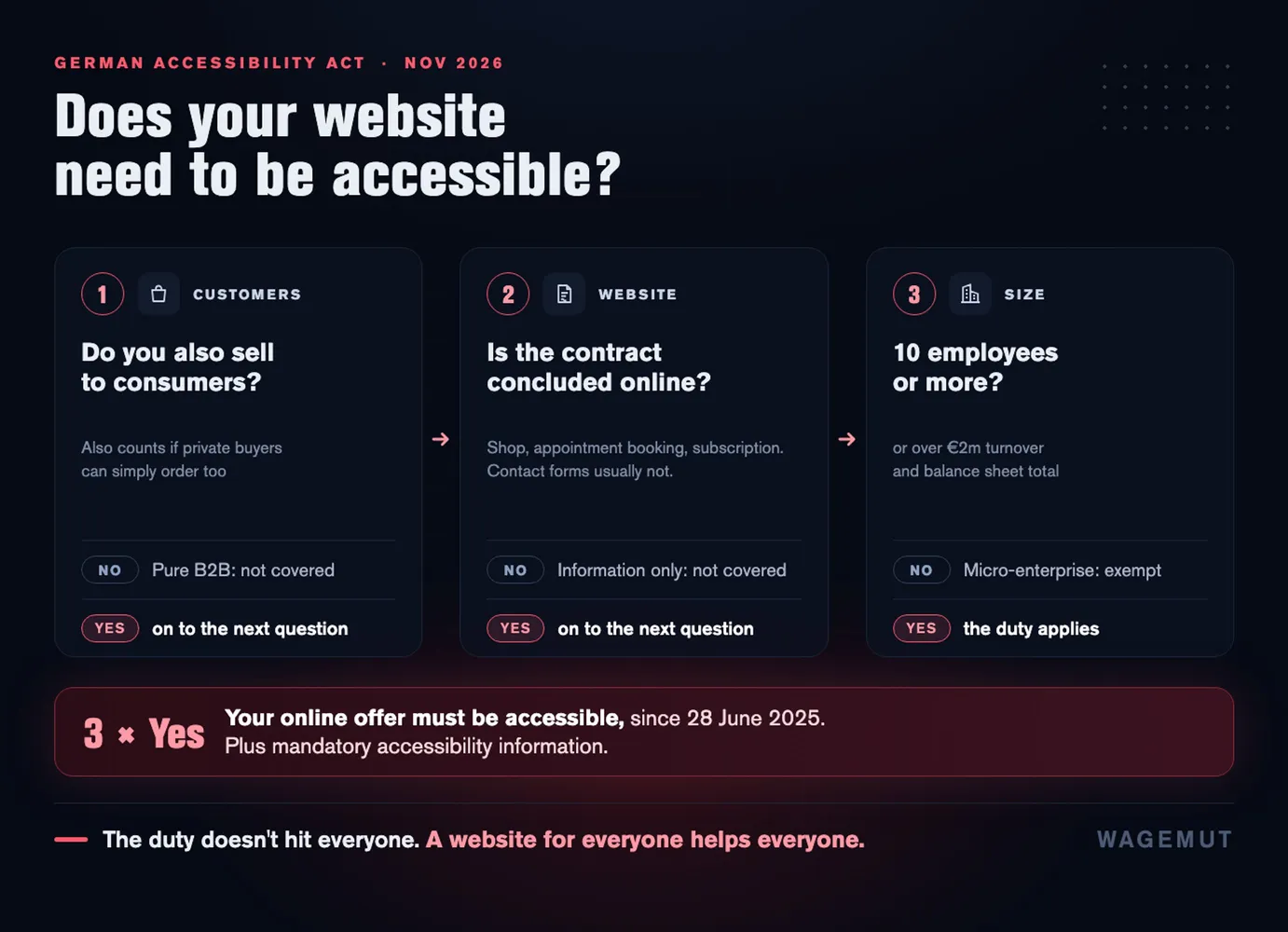
Question 1: consumers. The law applies to services provided “for consumers”. The German Confederation of Skilled Crafts (ZDH), drawing on information from the Federal Accessibility Agency, writes that offers aimed exclusively at businesses are not affected. The word “exclusively” is the catch. A B2B shop where anyone can order by credit card without checks is in practice open to private individuals too. If you only want to supply business customers, say so clearly and check it during ordering, for example via company name and VAT ID. Whether that is legally sufficient has not yet been decided by any court.
Question 2: contract online. Covered are websites through which a consumer contract is concluded: online shop, appointment booking, subscription, ordering. In its guidelines, the Federal Ministry of Labour and Social Affairs (BMAS) gives the example of a hairdresser who takes appointments online and sells care products. There, the entire website including the ordering process must be accessible. According to the ZDH, a contact form does not usually trigger the requirement, unless it serves directly to negotiate or conclude a contract. Newsletters and careers pages are generally not covered either.
Question 3: size. Micro-enterprises that provide services are exempt. A micro-enterprise is one that employs fewer than ten people and has an annual turnover of no more than 2 million euros or a balance sheet total of no more than 2 million euros. Both conditions must be met.
What this means for typical mid-sized company websites
Most websites we see in mechanical engineering and industry are image and product sites with a contact or enquiry form. According to the wording, they are not covered by the BFSG. Spare parts shops and configurators that lead directly to an order are more critical.
| Website type | Required under the BFSG? | Why |
|---|---|---|
| Image website with contact form | No | No contract is concluded on the website |
| Product catalogue with a form for quote requests | Probably not | A non-binding request is not yet a contract, not settled in court |
| B2B shop that only admits business customers and checks this | No | The offer is aimed exclusively at businesses |
| Spare parts shop where anyone can order | Probably yes | Consumers can conclude a contract too |
| Online appointment booking for private customers | Yes | Contract with consumers, example from the BMAS guidelines |
| Shop of a business with six employees and 1.5 million euros turnover | No | Exemption for micro-enterprises |
What an accessible website has to deliver
The ordinance accompanying the law requires a website to be “perceivable, operable, understandable and robust”. It doesn't prescribe a specific standard, the state of the art applies. In practice, that is the European standard EN 301 549. It refers to the Web Content Accessibility Guidelines (WCAG), the internationally recognised guidelines for accessible web content. If you're building something new today, WCAG 2.2 at level AA is the best guide.
In concrete terms, that means for example:
- Everything can be operated by keyboard, including the menu, forms and ordering process.
- Images have alternative texts that describe what can be seen.
- Text stands out clearly enough from the background.
- Headings are real headings in a sensible order.
- Form fields are labelled, and error messages say what to do.
- New videos have subtitles.
On top of that comes an obligation that is often overlooked. Anyone covered by the law must state how their offer meets the requirements, in the terms and conditions or in another clearly visible place on the website. This also names the competent market surveillance authority. Missing information is a violation in itself. There are no official templates for it.
One question the law leaves open: does the whole website have to be accessible, or only the shop? This is not clearly regulated. For its inspections, however, the law explicitly also names the home page, login, contact, help and the pages with legal information. If you're affected, you shouldn't only work on the ordering process.
Who checks and what happens in case of violations
The competent body is the federal states' market surveillance authority for the accessibility of products and services (MLBF) in Magdeburg. It has been operating nationwide since September 2025 and had received almost 700 reports by June 2026. It has not yet published figures on proceedings or fines.
The process is staged. The authority also carries out random checks without cause. If it finds shortcomings, it first sets a deadline for remedying them. Only after that can it order the offer to be discontinued. Fines go up to 100,000 euros for offering a service that is not accessible and up to 10,000 euros for other violations. Consumers and associations can also ask the authority to open proceedings.
Alongside this, there are legal warning letters. The first ones appeared in late summer 2025, with demands of around 1,000 euros. Whether BFSG violations can be pursued under the German Act against Unfair Competition (UWG) at all is disputed. We are not aware of any published ruling on this.
Pressure is more likely to grow. The European Commission considers Germany's implementation incomplete and stepped up ongoing infringement proceedings against Germany in March 2026.
So there's no need to panic. But looking away isn't an option either if you answer all three questions with yes.
Three persistent misconceptions
“A plugin makes the site accessible.” So-called overlay tools place a toolbar over the website that lets users adjust things like font size and contrast. According to the federal and state monitoring bodies quoted by the ZDH, they currently cannot make a website fully accessible and can even create new barriers, for example for screen readers. Accessibility lives in the code, not in a toolbar on top.
“Existing websites have a transition period until 2030.” No. The deadline of 27 June 2030 concerns products such as devices that a provider was already using before the cut-off date, and contracts concluded before 28 June 2025. Some guides read this as a grace period for shops. The wording doesn't support that.
“An automated test is enough.” Automated checking tools only find some of the errors. The testing method in the law covers entire processes, forms, error messages and use with assistive technologies such as screen readers. That takes people who actually click through the site.
Why accessibility pays off even without a requirement
According to the European Commission, more than 100 million people in the EU live with a disability. Add to that everyone whose eyesight is fading or who is standing in the sun with a smartphone.
Accessibility is also order in the code. Clean headings, labelled images and real buttons make a page understandable for screen readers. The same order helps machines read it. Google, for example, uses alternative text to understand what an image is about. That a clearly structured page also makes reading easier for AI assistants such as ChatGPT, Gemini and Claude is our assessment, not a measured effect. How to make pages readable for AI assistants is covered in the article on GEO optimization.
And you stand out. In a test published in June 2025 by Aktion Mensch, Google and the Pfennigparade foundation, only 20 of 65 popular German online shops could be used without a mouse. Worldwide, the organisation WebAIM found automatically detectable WCAG errors on 95.9 percent of the home pages of the one million most visited websites in early 2026. Do it properly and you're in the minority.
Accessibility is easiest when it's built in from the start. In our experience, it takes considerably more effort afterwards. If a website relaunch is coming up anyway, it belongs in the specification.
For most companies, the bigger risk isn't the fine anyway, but a website where some customers fail without anyone noticing.
Want to know whether your website is affected?
In 30 minutes via Teams, we go through the three questions for your website, show you the obvious barriers and what you should take on at your next relaunch anyway. Free of charge, and afterwards you know where you stand. Book a call.
This article reflects the situation as of November 2026 and is not a substitute for legal advice.
Sources
- Barrierefreiheitsstärkungsgesetz (BFSG), gesetze-im-internet.de (German)
- Ordinance on the BFSG (BFSGV), gesetze-im-internet.de, last amended 10 July 2026 (German)
- BMAS: Guidelines on the Barrierefreiheitsstärkungsgesetz (German)
- ZDH: FAQ on mandatory accessible design of company websites, February 2025, via Handwerkskammer Dortmund (German)
- MLBF: Questions and answers on the Barrierefreiheitsstärkungsgesetz (German)
- Ministry of Social Affairs of Saxony-Anhalt: New market surveillance authority takes shape in Magdeburg, 1 June 2026 (German)
- European Commission: Infringement package, INF/26/431, March 2026
- Händlerbund: BFSG warning letters, what retailers should do now, 2 September 2025 (German)
- FashionUnited: Two out of three online shops are not accessible, 17 June 2025 (German)
- WebAIM: The WebAIM Million, 2026
- Google Search Central: Google Images best practices